

Brain Fog Causes Adults: What’s Really Happening + How to Fix It
Medical Disclaimer: This content is for informational and educational purposes only. It does not constitute medical advice. Please consult your healthcare provider before making changes to your diet, supplements, or cognitive health routine.
Brain fog causes adults more cognitive disruption than most people realize — and the reasons go far deeper than poor sleep or stress. You sit down to work and the words won’t come. You walk into a room and forget why. A conversation that should be effortless feels like translating a language you used to speak fluently.
If this sounds familiar, you are not alone — and you are not imagining it.
Studies suggest that cognitive fatigue and persistent mental sluggishness affect hundreds of millions of adults worldwide at any given time. For the 30–55 demographic especially, that foggy, slow-motion feeling has become so normalized it gets treated as a personality trait rather than a symptom worth investigating.
But brain fog is not a diagnosis. It is a signal.
This article breaks down the actual neurological, hormonal, metabolic, and lifestyle mechanisms behind brain fog in adults — what the research says, what remains emerging, and what you can do about it today. No gimmicks. No miracle supplements. Just the clearest, most complete picture of what is happening inside your brain — and the evidence-based steps to change it.

What Is Brain Fog, Exactly?
Brain fog is not a clinical term you will find in the DSM-5 or the ICD-11. It is a descriptive umbrella — a cluster of cognitive symptoms that patients consistently report but that standard neurological tests often fail to catch.
Clinically, it maps to what researchers call subjective cognitive impairment (SCI) — measurable reductions in processing speed, working memory, attention, and executive function that do not yet meet the threshold for a diagnosable disorder like mild cognitive impairment (MCI).
What brain fog actually feels like in practice:
- Mental fatigue that doesn’t resolve with sleep
- Difficulty retrieving words or names mid-sentence
- Inability to focus on a single task for more than 10–15 minutes
- Feeling “slow” in conversations, especially under pressure
- Reading a paragraph and retaining nothing
- Decision fatigue that arrives earlier in the day than it used to
The distinction that matters most: brain fog is functional, not structural. There is typically no lesion, no tumor, no measurable neurodegeneration. The architecture is intact. The performance is not. That distinction is important — because it means the causes are usually modifiable, and so are the solutions.
The Most Common Brain Fog Causes Adults Experience
Brain fog rarely has a single origin. In most adults over 30, it is a convergence — several low-grade physiological stressors hitting the brain from different directions simultaneously. Here are the most well-documented mechanisms.
1. Chronic Sleep Deprivation and Disrupted Sleep Architecture
Sleep is not passive recovery. It is the most metabolically active state your brain enters.
During deep, slow-wave sleep, the glymphatic system — the brain’s waste-clearance network, first characterized by researchers at the University of Rochester — activates and flushes neurotoxic waste products, including beta-amyloid (associated with Alzheimer’s risk) and tau proteins. Miss enough sleep, and that waste accumulates.
But total hours are only part of the story. Sleep architecture matters just as much. Fragmented sleep — even 8 hours of interrupted, shallow sleep — significantly impairs next-day cognitive performance. Research published in Sleep found that just one week of sleeping 6 hours per night produced cognitive deficits equivalent to 24 hours of total sleep deprivation, while subjects rated themselves as only mildly tired. Most adults are cognitively impaired and have recalibrated their baseline so low they no longer recognize it.
What disrupts sleep architecture after 30:
- Blue light exposure after 9pm (suppresses melatonin release)
- Alcohol (collapses REM sleep in the second half of the night)
- Cortisol elevation from late-evening stress
- Undiagnosed sleep apnea, which affects roughly 1 in 4 adults over 30 and is far more common than most suspect
2. Chronic Stress and Cortisol Dysregulation
Cortisol is not inherently the enemy. In short bursts, it sharpens focus, mobilizes energy, and prepares the brain for action. The problem is duration.
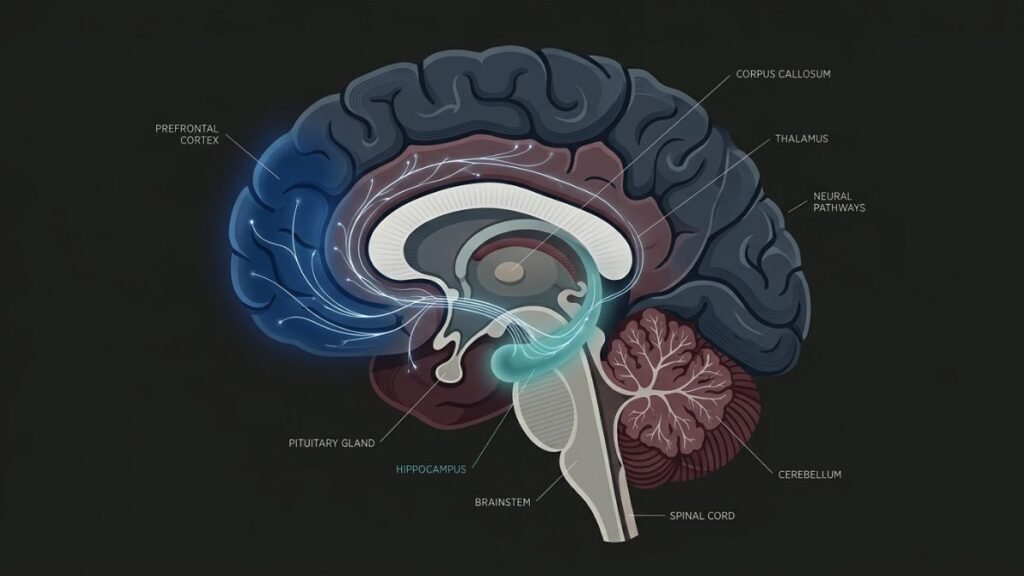
When cortisol remains elevated for weeks or months — increasingly common in modern adult life — it begins to erode the structures it is supposed to protect. The hippocampus, the brain region most central to memory formation and spatial navigation, has a high density of cortisol receptors. Chronic cortisol exposure causes hippocampal neurons to retract their dendrites — the branch-like structures responsible for forming synaptic connections — and in severe or prolonged cases, accelerates neuronal death.
A meta-analysis published in Psychoneuroendocrinology confirmed that elevated cortisol consistently predicts poorer performance on verbal memory, working memory, and processing speed tasks — exactly the domains that characterize brain fog.
Beyond the hippocampus, chronic stress also elevates neuroinflammatory cytokines (IL-6, TNF-α), disrupts dopamine and serotonin signaling, and impairs the prefrontal cortex — the region governing planning, sustained attention, and cognitive control.
3. Nutritional Deficiencies
The brain is roughly 2% of body mass but consumes approximately 20% of the body’s total energy and nutrient supply. Even subclinical deficiencies — levels that fall within “normal” lab ranges but not optimal ranges — can meaningfully impair cognition.
The most consistently implicated deficiencies in adult brain fog:
Vitamin B12 is essential for myelin synthesis — the fatty sheath that insulates nerve fibers and enables fast neural signal transmission. B12 deficiency is particularly common in adults over 40, those following plant-based diets, and individuals taking metformin or proton pump inhibitors. Critically, standard lab ranges can show “normal” B12 while tissue-level deficiency persists.
Vitamin D is now classified as a neurosteroid, not merely a bone-health nutrient. Vitamin D receptors are distributed throughout the brain, including the hippocampus and prefrontal cortex. Multiple studies associate low vitamin D (below 30 ng/mL) with increased cognitive complaints, depressive symptoms, and accelerated cognitive aging. An estimated 40–50% of adults in Western countries are deficient.
Magnesium is required for over 300 enzymatic reactions, including ATP production (cellular energy), NMDA receptor regulation (central to learning and memory), and serotonin synthesis. The majority of adults in developed nations consume below the recommended daily intake from diet alone.
DHA (Docosahexaenoic acid) is not just fuel — it is architecture. DHA is structurally integral to neuronal membranes. Low DHA intake is associated with reduced gray matter volume, increased neuroinflammatory markers, and measurably impaired cognitive performance in observational studies.
Iron — even mild iron deficiency anemia — impairs oxygen delivery to the brain, reducing focus, working memory, and cognitive endurance. More common in premenopausal women but underdiagnosed across all adult populations.
4. Hormonal Fluctuations and Dysregulation
Hormones are neurotransmitter modulators. Changes in their levels — which accelerate meaningfully from the mid-30s onward — directly alter brain function in ways that are frequently mistaken for aging or burnout.
In women: Estrogen plays a neuroprotective role, modulating serotonin, dopamine, and acetylcholine activity. The cognitive symptoms of perimenopause — brain fog, word retrieval difficulties, short-term memory lapses — are now well-documented. Research published in Menopause found that a majority of perimenopausal women report significant cognitive complaints affecting daily functioning, with many attributing them incorrectly to stress or overwork.
In men: Testosterone decline, which begins gradually from around age 30 at approximately 1% per year, is associated with reduced verbal memory, spatial cognition, and processing speed. The relationship is dose-dependent: lower circulating testosterone consistently correlates with worse cognitive performance on standardized tasks.
Thyroid function may be the most underdiagnosed hormonal driver of brain fog. Even subclinical hypothyroidism — elevated TSH with normal T4 — is associated with fatigue, cognitive slowing, and memory difficulty. Standard lab panels often miss the nuance; a full thyroid panel (TSH, free T3, free T4, and TPO antibodies) tells a more complete story.
5. Gut-Brain Axis Disruption
The gut is sometimes called the “second brain” — and for neurological purposes, that is not metaphor. The enteric nervous system contains approximately 500 million neurons and communicates bidirectionally with the central nervous system via the vagus nerve, immune signaling, and the production of neurotransmitter precursors.
Roughly 90% of the body’s serotonin is produced in the gut. Significant disruptions to gut microbiome diversity — caused by antibiotic use, ultra-processed diets, chronic stress, or insufficient dietary fiber — alter serotonin availability, increase intestinal permeability, and elevate systemic inflammatory markers capable of crossing the blood-brain barrier.
A review published in Frontiers in Neuroscience linked gut dysbiosis directly to cognitive fatigue, mood dysregulation, and impaired hippocampal function in adults — mechanisms that map precisely onto what patients describe as brain fog. The gut-brain axis is not a fringe concept; it is one of the most active areas in contemporary neuroscience research.
6. Neuroinflammation and Systemic Inflammation
Inflammation is the immune system’s first-responder mechanism. In the brain, it is mediated by microglia — resident immune cells that patrol for pathogens, clear debris, and modulate synaptic connectivity. When persistently activated, a state called neuroinflammation, microglia begin damaging healthy neurons and synapses in the process of “protecting” the tissue.
What drives chronic neuroinflammation in otherwise healthy adults:
- Diets high in refined sugars and ultra-processed foods
- Excess visceral adipose tissue (belly fat is metabolically inflammatory)
- Chronic psychological stress (directly elevates IL-6 and TNF-α)
- Environmental toxin exposure (air pollution, pesticide residues, heavy metals)
- Poor sleep — which itself prevents microglial cleanup during the glymphatic flush cycle
Neuroinflammation may be the final common pathway through which many different brain fog triggers converge into the same subjective experience.
7. Sedentary Lifestyle and Reduced Cerebral Blood Flow
The brain does not operate independently of the cardiovascular system. Every cognitive process depends on adequate cerebral perfusion — and aerobic fitness is one of the most powerful determinants of both baseline blood flow and the brain’s capacity to upregulate circulation on demand.
Physical activity also directly stimulates BDNF (Brain-Derived Neurotrophic Factor) — often described as fertilizer for neurons. BDNF supports neurogenesis (the birth of new neurons, primarily in the hippocampus), synaptic plasticity, and the maintenance of existing neural networks.
Sedentary adults show measurably lower hippocampal volume compared to age-matched active peers. A landmark study from the University of Illinois demonstrated that adults who walked at a moderate pace three times per week for a year showed meaningful increases in hippocampal volume — effectively reversing one to two years of age-related shrinkage through exercise alone.

Brain Fog vs. Something More Serious: When to See a Doctor
Before moving to solutions, this section must exist — because some brain fog is a symptom of an underlying condition that requires medical evaluation, not a lifestyle protocol.
Seek professional evaluation if you experience:
- Sudden or rapid onset of cognitive symptoms rather than a gradual slide
- Brain fog accompanied by significant depression, anxiety, or mood shifts
- Unexplained weight changes alongside cognitive symptoms
- Cognitive symptoms following a viral illness (post-COVID cognitive syndrome is well-documented and distinct from lifestyle-driven fog)
- Memory difficulties affecting your ability to manage daily responsibilities
- Word-finding problems that are consistently worsening, not fluctuating
Conditions that commonly present with brain fog and require diagnosis: Hypothyroidism and Hashimoto’s thyroiditis, anemia (multiple types), type 2 diabetes and insulin resistance, sleep apnea, clinical depression and anxiety disorders, autoimmune conditions including lupus and fibromyalgia, Long COVID, and early-stage mild cognitive impairment.
This article is not a substitute for that evaluation. If in doubt, get labs before you get supplements.
Know More: Brain Basics – Understanding Sleep
The Neuroscience Behind Brain Fog: What’s Actually Happening
When you experience brain fog, several things are happening neurologically — often simultaneously.
Impaired cholinergic signaling. Acetylcholine — the primary neurotransmitter for attention, learning, and memory consolidation — is among the first systems to degrade under nutritional deficiency, sleep loss, and the normal aging process. The difficulty retrieving information that characterizes brain fog often reflects acetylcholine insufficiency at the synaptic level.
Dopamine dysregulation. Dopamine drives motivation, cognitive engagement, and the reward circuitry that makes thinking feel worth the effort. Chronic stress, poor sleep, and dopamine-depleting lifestyle patterns — excessive social media, ultra-processed food, physical inactivity — flatten dopamine signaling, producing the “can’t get started” quality that many brain fog sufferers describe.
Mitochondrial insufficiency. Brain cells are among the most metabolically demanding cells in the body. When mitochondrial efficiency drops — through oxidative stress, nutrient depletion, or sedentary lifestyle — ATP production in neurons falls below what sustained cognitive work requires. Mental fatigue is, in part, a cellular energy crisis.
Default mode network dysregulation. The DMN — the network active during rest, self-reflection, and background cognitive processing — becomes dysregulated under chronic stress and sleep deprivation. This explains the “scattered” quality of brain fog: the inability to maintain a coherent internal narrative or sustain a train of thought.
How to Fix Brain Fog: Evidence-Based Strategies
This is where most articles become vague. Here, the specificity matters.
Optimize Sleep Architecture, Not Just Hours
Target 7–9 hours, but also protect the architecture. Consistent sleep and wake times — including weekends — are the most powerful regulator of circadian rhythm and deep sleep quality. Eliminate blue light exposure after 9pm or use blue-light-blocking glasses rated to reduce 480nm wavelength light. A cooler sleep environment (65–68°F / 18–20°C) measurably deepens slow-wave sleep. If snoring, gasping, or consistently non-restorative sleep is present, rule out sleep apnea before implementing any other protocol.
Target Confirmed Nutritional Deficiencies
Get baseline labs first: B12, 25-OH Vitamin D, ferritin (iron stores), a complete thyroid panel (TSH, free T4, free T3, TPO antibodies), and a CRP or hs-CRP to establish your systemic inflammation baseline. Supplement what the labs confirm — not what marketing suggests.
Dietary priorities with strong cognitive evidence: fatty fish 2–3 times weekly for DHA, magnesium-rich whole foods (pumpkin seeds, dark leafy greens, legumes), and a dramatic reduction in ultra-processed food and added sugar — the primary dietary drivers of neuroinflammation.
Intervene at the Cortisol Level
Zone 2 aerobic exercise — conversational-pace cardio, 30–45 minutes, 3–5 times per week — is the single most effective cortisol-regulating intervention available without a prescription. It also directly stimulates BDNF and cerebral blood flow simultaneously.
The physiological sigh — a double inhale through the nose followed by an extended exhale through the mouth — activates the parasympathetic nervous system within seconds. Research from Stanford validates this as one of the fastest voluntary interventions for acute stress reduction.
Ashwagandha (KSM-66 extract) has multiple randomized controlled trials showing meaningful cortisol reduction at 300–600mg/day. This is promising — but individual response varies, and it is contraindicated in pregnancy and some autoimmune conditions. Discuss with your physician before use.
Make Exercise Non-Negotiable
The dose that appears most effective for cognitive outcomes in the literature: 150 minutes per week of moderate aerobic intensity, minimum. This is not about fitness — it is about BDNF, cerebral blood flow, and hippocampal volume preservation. Resistance training at 2 sessions per week confers independent cognitive benefits, including improved executive function and processing speed, separate from aerobic effects.
Timing matters: exercise performed before cognitively demanding work measurably improves subsequent performance in multiple studies.
Feed the Gut-Brain Axis
25–38 grams of dietary fiber daily from whole food sources is the most evidence-supported intervention for microbiome diversity. A 2021 Stanford study found that a diet rich in fermented foods — kefir, kimchi, sauerkraut, unsweetened yogurt — increased microbiome diversity and reduced inflammatory markers more effectively than a high-fiber diet alone over the same period. Use both strategies, not one.
Minimize antibiotic use to what is medically necessary. If you must use antibiotics, discuss targeted probiotic supplementation with your physician during and after the course.
Practice Cognitive Hygiene
Brain fog is not purely chemical. Cognitive environment is a legitimate variable.
Monotasking over multitasking — task-switching carries a measurable cognitive cost that accumulates across a workday and mimics fog. Strategic recovery breaks aligned with the approximately 90-minute ultradian rhythm reduce the fatigue that builds from pushing through natural cognitive low phases. Digital friction reduction — notifications off during focused work — is not productivity advice; it is a neurological intervention.

If you have addressed your foundational deficiencies and are looking for additional cognitive support, read our guide on the [best nootropics for focus and mental clarity] to understand which supplements have the strongest evidence behind them.”
What Actually Works vs. What Is Mostly Marketing
Strong, consistent evidence:
- Sleep architecture optimization
- Aerobic and resistance exercise
- Correcting confirmed nutritional deficiencies (B12, D, iron)
- Anti-inflammatory dietary patterns — the Mediterranean diet has the deepest cognitive evidence base of any dietary approach
Promising but not yet conclusive:
- Ashwagandha for cortisol and cognitive stress (multiple RCTs, but individual variability is high)
- Lion’s Mane mushroom (hericenones and erinacines may stimulate NGF — Nerve Growth Factor — but human trial quality remains limited)
- Bacopa monnieri for working memory (modest, accumulating effects over 8–12 weeks)
- Phosphatidylserine for age-related cognitive maintenance
Mostly marketing:
- Any supplement claiming instant cognitive enhancement without a disclosed mechanism of action
- “Brain cleanse” or detox protocols — the glymphatic system performs this function more efficiently than any product
- Nootropic blends with ingredients under-dosed below threshold efficacy
- Products making guarantees about cognitive results for all users — this is not how brain chemistry works
Building Your Anti-Brain-Fog Protocol
Rather than overhauling everything at once — which is itself cognitively taxing — approach this sequentially.
Weeks 1–2: Establish your baseline. Get labs: B12, Vitamin D, ferritin, thyroid panel, CRP. Commit to consistent sleep and wake times, 7 days a week. Log your diet for 5 days — not to count calories, but to identify personal inflammation patterns.
Weeks 3–4: Build the foundation. Add 30 minutes of zone 2 cardio three times per week. Address confirmed deficiencies with targeted, physician-guided supplementation. Remove one processed food category (start with added sugar in beverages — it is the highest-leverage, lowest-friction change).
Weeks 5–8: Optimize systematically. Add resistance training twice per week. Introduce fermented foods daily. Implement digital friction reduction during your peak cognitive hours. Reassess symptoms objectively — brain fog has a subjective quality that makes it easy to dismiss progress unless you track it deliberately.
This is not a sprint. Hippocampal neurogenesis takes 4–6 weeks of consistent aerobic exercise before measurable changes appear. Vitamin D repletion takes 8–12 weeks to normalize at the tissue level. Patience, applied systematically, is the primary intervention.
You might be interested to know: How Long Does Brainwave Entrainment Take to Work? A Complete Guide
Conclusion
Brain fog in adults is not a character flaw, an inevitable consequence of aging, or a problem that dissolves with willpower alone. It is a physiological signal — usually the convergence of several addressable mechanisms — and the research is increasingly clear on both the causes and the corrective strategies.
The three actions most likely to move the needle: fix your sleep architecture, get your labs done, and make aerobic exercise non-negotiable. Everything else builds from that foundation.
You are not broken. Your brain is asking for specific inputs that modern life has made genuinely difficult to provide. Now you know exactly what those inputs are.
Frequently Asked Questions
What is the most common cause of brain fog in adults?
There is rarely a single cause. In most adults, brain fog reflects a convergence of chronic sleep disruption, elevated cortisol from sustained stress, subclinical nutritional deficiencies (particularly B12, vitamin D, and magnesium), and neuroinflammation driven by diet and lifestyle. Identifying your specific combination — ideally with baseline labs — is a more effective approach than guessing.
Can brain fog be a sign of something serious?
Yes, in some cases. While most adult brain fog is lifestyle-driven and reversible, it can also be a symptom of hypothyroidism, sleep apnea, anemia, autoimmune conditions, post-viral syndrome (including Long COVID), or early-stage cognitive impairment. If symptoms are sudden, worsening, or accompanied by other systemic changes, a medical evaluation should precede any self-treatment protocol.
How long does it take to clear brain fog?
It depends entirely on the underlying cause. Correcting acute sleep deprivation can produce measurable cognitive improvement within 1–2 weeks of consistently quality sleep. Nutritional deficiency correction typically takes 8–12 weeks. Exercise-driven BDNF and hippocampal improvements accumulate over 4–8 weeks of consistent aerobic training. Most people notice meaningful functional improvement within 4–6 weeks of addressing their primary drivers.
Are nootropics effective for brain fog?
Some have modest, credible evidence — bacopa monnieri, lion’s mane, and phosphatidylserine have the most peer-reviewed support. However, no supplement reliably resolves brain fog if the foundational lifestyle and deficiency drivers remain unaddressed. Nootropics function best as optimization tools on top of a solid foundation, not as substitutes for sleep, nutrition, and exercise.
Is caffeine making my brain fog worse?
Possibly. Caffeine blocks adenosine receptors — adenosine being the molecule that signals fatigue — creating a perception of alertness while underlying fatigue accumulates beneath it. Excessive caffeine, particularly consumed after noon, disrupts sleep architecture and compounds cognitive fatigue the following day. If you require more than two cups to feel functional, the caffeine may be masking the problem rather than resolving it.
Can stress alone cause brain fog?
Yes, and the mechanism is well-documented. Chronic cortisol elevation directly impairs hippocampal function, disrupts dopamine and acetylcholine signaling, and promotes neuroinflammation — all of which produce the cognitive symptoms associated with brain fog. In many adults, psychological stress is the primary driver, and symptoms improve significantly when stress physiology — not merely stress behavior — is addressed.
Should I see a doctor about brain fog?
If your brain fog persists for more than 4 weeks, is worsening over time, significantly impacts daily function, or is accompanied by fatigue, mood changes, or other systemic symptoms, a medical evaluation is the appropriate first step. A basic blood panel — B12, vitamin D, ferritin, thyroid, CRP — provides information that no supplement protocol can substitute for.