

Context Switching: Why It Drains Your Focus and How to Regain Control
If you feel constantly busy yet strangely unproductive, context switching may be the silent force draining your focus. Every notification, tab change, and task hop seems harmless in isolation. Together, they create a cognitive tax that compounds throughout the day.
Recent productivity and neuroscience research shows that frequent task switching can reduce effective productivity by 20–40%, not because of poor discipline, but because the brain pays a measurable cost every time it reorients attention.
In modern knowledge work, context switching is often mislabeled as multitasking. In reality, the brain does not multitask. It toggles rapidly between contexts, consuming working memory and increasing mental fatigue.
This article explains why context switching drains your focus, how it affects cognitive performance and mental health, and what evidence-based strategies help reduce its impact.
What Context Switching Really Is (and What It Isn’t)
Defining context switching
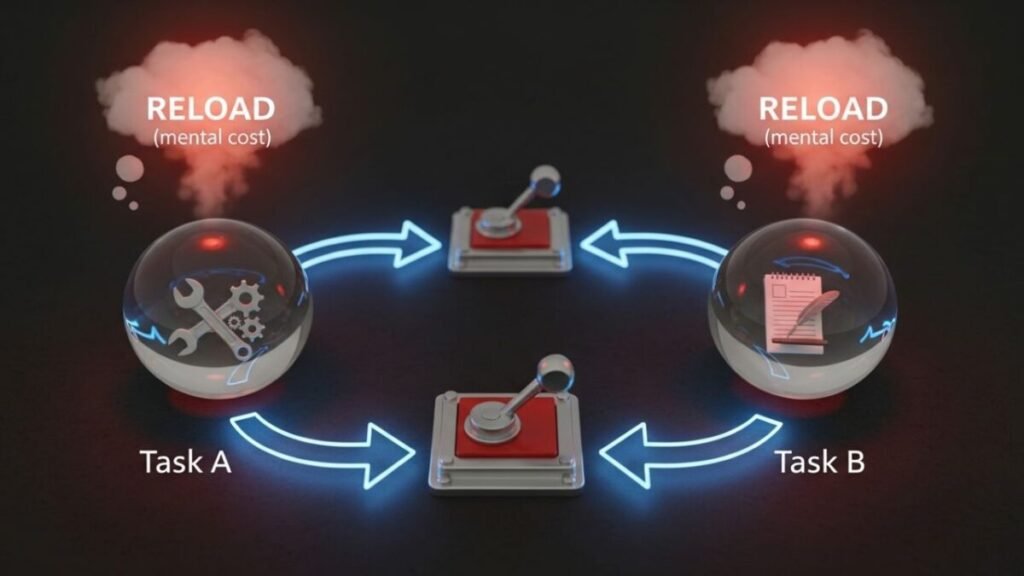
Context switching happens when your brain shifts from one task, rule set, or mental environment to another. Writing a report, checking email, replying to a message, then returning to the report is a classic example.
Each switch forces the brain to unload one task context and reload another, which is neither instant nor free.
If this topic resonates, you may also want to explore:
Select Cognitive Exhaustion: Why Your Brain Feels Tired Even When You’re Not Doing Much
Multitasking vs. task switching
Multitasking implies parallel processing. For complex cognitive tasks, this is largely a myth. What feels like multitasking is actually serial switching, which degrades performance and accuracy.
The Neuroscience Behind Focus Loss
Attention residue and working memory
One of the most studied mechanisms behind context switching is attention residue. When you leave a task, part of your attention stays attached to it, reducing the mental resources available for the next task.
This concept was first explored in depth by organizational psychologist Sophie Leroy and later reinforced by cognitive neuroscience research.
See also: American Psychological Association – attention and task switching
Executive control fatigue
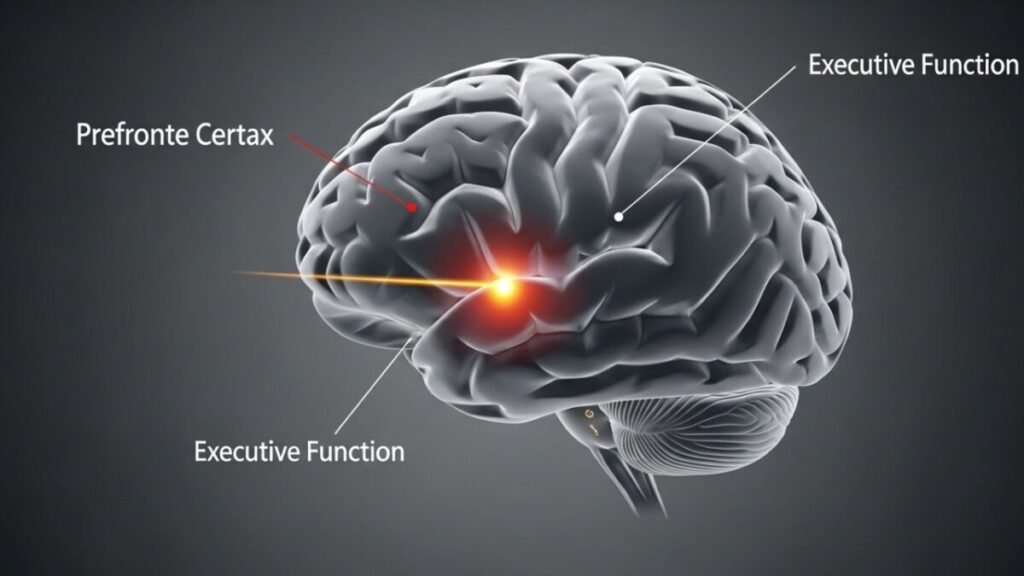
Every switch requires executive control, managed primarily by the prefrontal cortex. Repeated switching overloads this system, leading to slower thinking, more errors, and reduced impulse control.
To learn more, see also:
Cognitive Exhaustion: Why Your Brain Feels Tired Even When You’re Not Doing Much
How Context Switching Impacts Mental Health and Performance
Cognitive performance consequences
Frequent context switching is associated with:
- Slower task completion
- Increased error rates
- Reduced creative and strategic thinking
These effects are especially visible in knowledge work requiring deep reasoning or long-term planning.
Emotional and mental health effects
Beyond productivity, constant task switching contributes to elevated stress, irritability, and mental exhaustion. Over time, this fragmentation is linked to burnout symptoms.
Common Triggers You May Be Overlooking
Digital notifications
Even when ignored, notifications create anticipation and cognitive disruption. Studies show that simply knowing a message is waiting reduces focus.
Open loops and unfinished tasks
Unfinished tasks remain active in working memory, increasing the urge to switch. This is why task clarity is essential for sustained focus.
The Real Cost of Context Switching (Comparative View)
| Work Pattern | Average Switches per Hour | Effective Focus Time | Error Rate |
|---|---|---|---|
| Deep focus blocks | 2–4 | High | Low |
| Moderate switching | 8–12 | Medium | Medium |
| Constant switching | 20+ | Low | High |
Evidence-Based Strategies to Reduce Context Switching
Time-blocking and task batching
Grouping similar tasks dramatically reduces context switches. Email, messaging, and administrative work should be handled in predefined windows.
Notification hygiene
Disable non-essential alerts and move communication apps off your main workspace. Reducing triggers is often more effective than relying on willpower.

Transition rituals
When switching is unavoidable, briefly note what you just did and what comes next. This reduces cognitive reload time later.
A Practical Daily Checklist
- Plan 2–3 uninterrupted focus blocks
- Batch communication twice per day
- Close unused tabs and apps
- Define the next concrete action before starting
- End the day by closing open loops
Common Myths About Context Switching
“I work better under constant stimulation”
Short bursts of novelty may feel energizing, but sustained performance depends on depth, not stimulation.
“Fast responders are more productive”
Responsiveness is often confused with effectiveness. High-quality output requires protected focus time.
When Context Switching Is Unavoidable
Some roles demand responsiveness. In these cases:
- Define priority channels
- Set clear response expectations
- Protect at least one daily deep-focus block
Even small reductions in switching frequency can significantly improve mental clarity.
Conclusion: Focus Is a System, Not a Personality Trait
Context switching drains your focus not because of a lack of discipline, but because the brain incurs real cognitive costs every time it changes gears. By designing better systems, environments, and boundaries, you can reclaim depth and mental energy without forcing constant self-control.
Focus is not about trying harder. It is about switching less.
Health & Well-Being Disclaimer:
This content is for informational and educational purposes only and does not replace professional medical or psychological advice. If you experience persistent attention difficulties, stress, or mental health concerns, consult a qualified professional.
FAQ: Context Switching
What is context switching in productivity?
Context switching is the mental process of shifting attention between tasks, tools, or goals, which creates cognitive overhead.
Why does context switching reduce focus?
Because attention residue and executive fatigue limit the brain’s available resources.
Is multitasking the same as context switching?
No. Most multitasking is rapid task switching, not true parallel processing.
Can context switching affect mental health?
Yes. Chronic fragmentation is associated with stress, fatigue, and burnout symptoms.
How can I reduce context switching at work?
Batch tasks, reduce notifications, and protect uninterrupted focus blocks.