

Why Memory Gets Worse After 35: What the Science Says
Understanding why memory gets worse after 35 starts with one uncomfortable fact: the biological changes behind it begin earlier than most people realize, progress more quietly than expected, and are driven by mechanisms that go far beyond simply “getting older.”
This is not inevitable cognitive decline. It is a predictable neurological process with identifiable drivers — and a growing body of research showing that several of those drivers are modifiable.
If you’ve noticed that names don’t come as easily as they once did, that you lose your train of thought mid-sentence, or that learning new information requires more repetition than it used to — you’re not imagining it. And you’re not alone. Studies suggest that measurable changes in memory speed and verbal recall begin appearing in the mid-30s, well before what most people think of as “age-related” cognitive change.
This article explains exactly what is happening in your brain after 35, which biological mechanisms are responsible, and what the current scientific evidence actually supports as effective intervention. No supplements are required to benefit from this information — though the mechanisms covered here explain precisely why certain nutritional strategies do and don’t work.
This content is for informational and educational purposes only. It does not constitute medical advice. Please consult your healthcare provider before making changes to your diet, supplements, or cognitive health routine.
Why Memory Gets Worse After 35: What’s Happening in Your Brain
The human brain reaches its peak structural volume around age 25. After that, a gradual process of change begins — not dramatic loss, but a slow shift in the efficiency and architecture of neural systems.
The region most relevant to memory is the hippocampus — a curved structure in the brain’s temporal lobe that acts as the central processing hub for encoding new memories and consolidating short-term experience into long-term storage. Research published in the Proceedings of the National Academy of Sciences found that hippocampal volume decreases at a rate of approximately 1–2% per year in healthy adults over 40, with measurable functional consequences for episodic memory (the memory of events and experiences). [1]
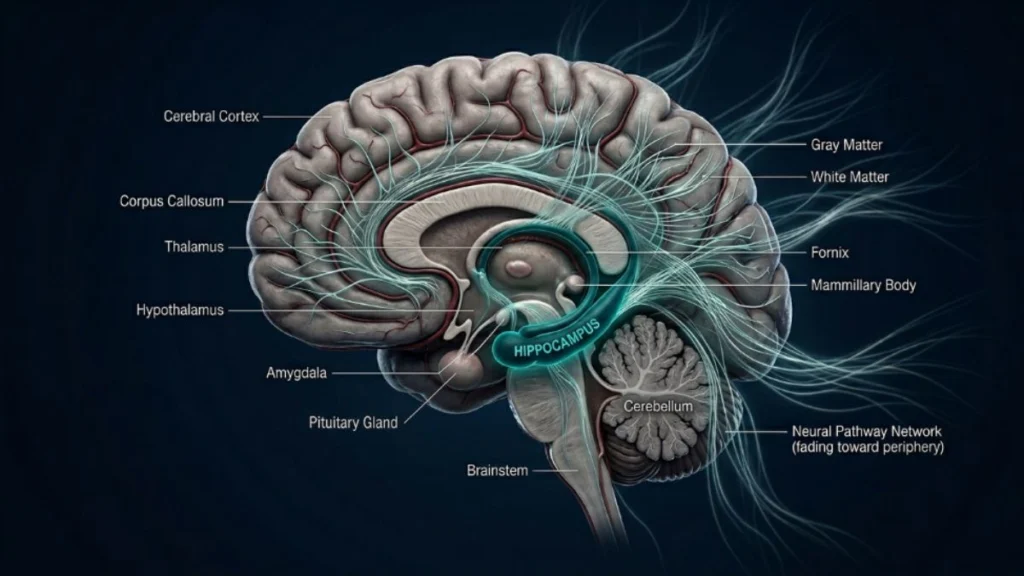
Two other structural changes matter:
Myelin degradation. Myelin is the insulating sheath around nerve fibers that allows electrical signals to travel at high speed. As it degrades with age, processing speed slows — which is why the word is “on the tip of your tongue” rather than immediately accessible. The memory is there. The retrieval pathway is slower.
Synaptic density reduction. The number of active connections between neurons gradually decreases in regions associated with working memory and executive function. This affects not just what you remember, but how many things you can hold in mind simultaneously.
Key insight: The most common early-stage memory changes after 35 — slower name recall, reduced multitasking capacity, difficulty learning under distraction — are primarily retrieval and processing speed problems, not storage problems. Your memories are not disappearing. The access pathways are becoming less efficient.
The 4 Biological Drivers of Memory Decline After 35
1. Acetylcholine Decline
Acetylcholine is the neurotransmitter most directly linked to attention, learning, and memory consolidation. It plays a central role in the hippocampal encoding process — essentially, it is the chemical signal that tells your brain “this information is worth retaining.”
Acetylcholine synthesis depends on a precursor compound called choline, plus an enzyme called choline acetyltransferase (ChAT). Both the availability of choline in the diet and the activity of ChAT begin declining in midlife. The result is a gradual reduction in cholinergic signaling — the brain’s internal “pay attention” system becomes less responsive, particularly under stress or sleep deprivation.
The acetylcholine connection: Alzheimer’s disease is characterized in part by severe cholinergic neuron loss — which is why many prescription cognitive medications (like donepezil) work by inhibiting acetylcholine breakdown. The age-related decline in healthy adults is far less severe, but the same pathway is involved.
2. Cortisol Chronicity
Cortisol — the primary stress hormone — is directly neurotoxic to hippocampal neurons when chronically elevated. This is one of the most significant and most overlooked drivers of memory change in adults in their 30s and 40s.
Acute cortisol release (in response to a real stressor) is normal and protective. Chronic elevation — the low-level cortisol excess that characterizes sustained occupational stress, poor sleep, and inadequate recovery — physically reduces hippocampal volume over time. A landmark study from Stanford University found that adults with chronically elevated cortisol performed significantly worse on memory tests and showed measurably smaller hippocampi than age-matched controls with lower cortisol baselines.
This is the mechanistic explanation behind why “stress makes you forgetful” is not a metaphor. It is a neurological reality.

3. Reduced Neuroplasticity
Neuroplasticity is the brain’s ability to form new neural connections, reorganize existing pathways, and adapt to new information. It is what underlies learning. It does not disappear with age — but it does require more deliberate conditions to activate.
The key molecular driver of neuroplasticity is BDNF — Brain-Derived Neurotrophic Factor. Often described as “fertilizer for neurons,” BDNF supports the growth, survival, and differentiation of neurons, and is essential for the synaptic strengthening process underlying long-term memory formation.
BDNF levels decline with age, sedentary behavior, poor sleep, and chronic stress. This means that for adults in their 30s and 40s who are physically inactive and chronically stressed, neuroplasticity is being suppressed by multiple overlapping mechanisms simultaneously.
The good news: BDNF is one of the most responsive biomarkers to lifestyle intervention. Aerobic exercise in particular produces robust, acute increases in BDNF — a finding replicated across dozens of human trials and one of the strongest evidence bases in cognitive neuroscience.
4. Cerebral Blood Flow Reduction
The brain consumes approximately 20% of the body’s total oxygen supply despite representing only 2% of body mass. It is extraordinarily dependent on consistent, high-volume blood flow for glucose and oxygen delivery.
After 35, several factors converge to reduce cerebral blood flow: early arterial stiffening, reduced cardiovascular fitness in sedentary adults, and declining nitric oxide production (which regulates blood vessel dilation). The result is that neurons — particularly in the prefrontal cortex and hippocampus — receive slightly less of the fuel they need to function optimally.
This is why cardiovascular health and cognitive health are so deeply linked. They share the same delivery infrastructure.
The Difference Between Normal and Concerning Memory Changes
Not all memory changes are equal — and knowing the distinction is important both for your peace of mind and for making informed decisions about when to seek medical evaluation.
| Normal Memory Change After 35 | Potentially Concerning — Seek Evaluation |
|---|---|
| Slower name recall (word is accessible, just delayed) | Forgetting names of close family members |
| Occasionally losing your train of thought | Frequently losing track of what you were saying mid-sentence |
| Misplacing items (keys, phone) occasionally | Placing objects in unusual locations (freezer, dishwasher) |
| Taking longer to learn new skills | Inability to retain new information after multiple repetitions |
| Difficulty multitasking under stress | Getting confused in familiar environments |
| Needing more repetition to memorize something | Asking the same question multiple times in a short period |
| Momentarily forgetting an appointment | Missing appointments repeatedly and not recalling them afterward |
Important: If memory changes are sudden, rapidly progressive, or accompanied by personality changes, disorientation, or functional impairment, medical evaluation should not be delayed. These can indicate conditions (including thyroid dysfunction, B12 deficiency, depression, or early neurodegenerative disease) that are treatable when identified early.
What the Research Says You Can Actually Do
This is where the science becomes actionable. The following interventions have the strongest evidence bases for supporting memory and cognitive function in mid-life adults. None of them require supplements — though the mechanisms described here explain why some supplements work when they do.
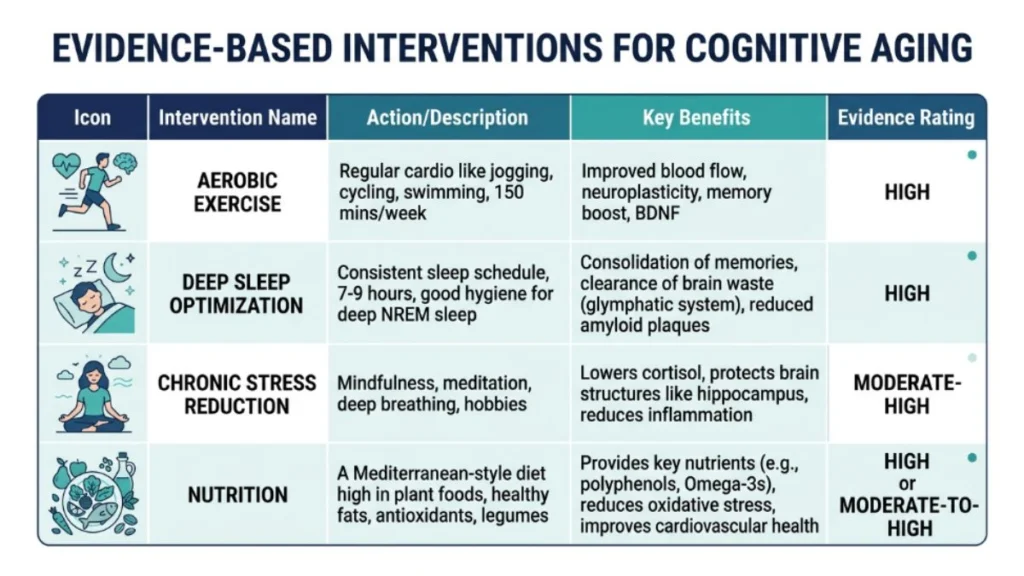
| Intervention | Primary Mechanism | Evidence Level | Minimum Effective Dose |
|---|---|---|---|
| Aerobic exercise | BDNF elevation, cerebral blood flow, hippocampal volume | Very strong — multiple RCTs | 150 min/week moderate intensity |
| Deep sleep optimization | Memory consolidation, glymphatic clearance | Very strong | 7–9 hours; slow-wave sleep is critical |
| Chronic stress reduction | Cortisol normalization, hippocampal protection | Strong | Consistent practice — not acute interventions |
| Dietary choline | Acetylcholine precursor availability | Moderate — observational + mechanistic | Eggs, liver, fish; ~425–550mg/day |
| Mediterranean-style diet | Reduced neuroinflammation, vascular health | Strong — longitudinal cohort data | Adherence over years, not weeks |
| Cognitive challenge | Neuroplasticity stimulation, synaptic density | Moderate | Novel learning, not repetitive familiar tasks |
Exercise and BDNF: The Strongest Evidence You Have
A 2011 study published in PNAS (Kirk Erickson et al.) found that one year of aerobic exercise increased hippocampal volume by approximately 2% in older adults — effectively reversing one to two years of age-related hippocampal shrinkage. [2] This remains one of the most cited findings in cognitive aging research.
The mechanism is BDNF: aerobic exercise produces acute BDNF release within the hippocampus, which stimulates neurogenesis (the growth of new neurons) and synaptic strengthening. Resistance training also produces cognitive benefits, but through different pathways — primarily via IGF-1 (insulin-like growth factor) and improved cerebral blood flow.
The implication is direct: sedentary behavior in midlife is not a neutral baseline for cognitive aging. It is an active accelerant.
Sleep Is When Memory Gets Written
During deep slow-wave sleep, the brain replays the day’s experiences and transfers them from the hippocampus (short-term buffer) into the cortex (long-term storage). This consolidation process is not optional — it is the mechanism of long-term memory formation.
Sleep quality — not just duration — deteriorates progressively after 35. The percentage of time spent in deep slow-wave sleep decreases with each decade. Adults who chronically sleep six hours or fewer show significantly accelerated cognitive aging in longitudinal studies. The effects are cumulative and, beyond a certain threshold, not fully reversible by a single night of recovery sleep.
One of the most underestimated cognitive interventions available to any adult over 35 is improving sleep quality — not as a lifestyle preference, but as a direct neurological maintenance strategy.
If you suspect that lack of sleep is causing cognitive changes, it’s worth addressing this issue. Check out our article on The Best Supplements for Sleep and Cognitive Performance (2026) to learn about evidence-based strategies.
Stress: The Silent Memory Shredder
Chronic stress is unique among cognitive risk factors because it impairs memory through at least four simultaneous pathways: cortisol-mediated hippocampal damage, impaired deep sleep, reduced BDNF, and disrupted acetylcholine signaling. Managing chronic stress is not a wellness nicety — it is the single most high-leverage intervention available for mid-life memory protection.
The most evidence-backed stress reduction approaches for cognitive aging are mindfulness-based stress reduction (MBSR), regular aerobic exercise (which also addresses BDNF simultaneously), and consistent sleep scheduling.
Lifestyle Factors That Accelerate Memory Decline After 35
Some behaviors common in high-performing adults in their 30s and 40s are particularly damaging to cognitive aging trajectories:
Alcohol consumption. Even moderate regular drinking — two drinks per night — has been associated with accelerated hippocampal volume loss in observational studies. The BRAIN+ UK cohort study found that people who drank within low-risk guidelines still showed more hippocampal shrinkage than abstainers.
Chronic sleep restriction. Four to six hours per night, even for a few months, produces measurable deficits in memory consolidation and executive function that are not subjectively perceived as impairment — meaning most people don’t know how cognitively compromised they are.
Ultra-processed diet. Dietary patterns high in ultra-processed foods are independently associated with accelerated cognitive aging, likely through neuroinflammatory pathways and vascular damage.
Social isolation. Reduced social engagement is one of the strongest independent predictors of cognitive decline in midlife, separate from physical health variables. The mechanism involves both cognitive stimulation and stress hormone regulation.
The pattern that most accelerates cognitive aging in the 35–55 cohort: high stress + poor sleep + sedentary behavior + high alcohol intake. Each factor amplifies the others. Addressing even one of the four tends to produce measurable improvement across the others.
What About Cognitive Supplements?
The mechanisms described throughout this article — acetylcholine decline, BDNF reduction, cortisol elevation, cerebral blood flow reduction — are the same mechanisms that well-researched nootropic ingredients target. This is why understanding the neuroscience matters before evaluating supplements: it tells you exactly which claims are mechanistically plausible and which are marketing noise.
Ingredients like Bacopa Monnieri, Citicoline, Rhodiola Rosea, Phosphatidylserine, and Lion’s Mane Mushroom each address at least one of the biological drivers covered in this article. The strongest supplement options are not replacements for the lifestyle interventions above — but for adults who are already addressing sleep, exercise, and stress, they can meaningfully support the neurochemical environment underlying memory function.
For a full breakdown of which stimulant-free nootropic stacks have the most clinical evidence, see our guide to choosing a Nootropic Stack for Brain Fog: Stimulant-Free Buyer’s Guide.
See our list of the Best Nootropics for Focus: The 2026 Science-Backed Guide
Conclusion
Memory decline after 35 is real, measurable, and driven by four specific biological mechanisms: acetylcholine reduction, chronic cortisol elevation, declining neuroplasticity, and reduced cerebral blood flow. None of these are purely genetic inevitabilities. Each has identifiable behavioral and nutritional drivers — and an increasingly strong evidence base for intervention.
Three things to take from this article:
- The most common early-stage memory changes in adults 35–50 are retrieval speed problems, not storage loss. Your memories are largely intact — the access pathways are slowing down.
- Aerobic exercise, deep sleep, and chronic stress management have the strongest and most consistent evidence bases for protecting cognitive function in midlife — stronger than any supplement category.
- Cognitive aging is a gradient, not a cliff. The choices made in the 35–50 window have a disproportionate effect on the trajectory of the following decades.
The science here is not pessimistic. It is directional. Knowing what’s happening is the prerequisite for doing something about it.
This content is for informational and educational purposes only. It does not constitute medical advice. Please consult your healthcare provider before making changes to your diet, supplements, or cognitive health routine.
Frequently Asked Questions
At what age does memory actually start to decline?
Research consistently shows that measurable changes in certain memory functions — particularly processing speed and verbal recall under pressure — begin appearing in the mid-30s. More noticeable changes in episodic memory (remembering specific events) typically become apparent in the 40s. However, the rate and severity vary significantly based on lifestyle, genetics, and overall health.
Is memory loss after 35 normal or should I be worried?
Gradual, mild changes in recall speed and multitasking ability are considered a normal part of cognitive aging. What warrants medical evaluation is memory change that is rapid, progressively worsening, affects daily function, or is accompanied by personality changes, disorientation, or difficulty with familiar tasks. When in doubt, consult your healthcare provider — many causes of accelerated memory change are treatable.
Can you reverse memory decline after 35?
Research suggests that some aspects of age-related memory change are reversible or can be significantly slowed, particularly through aerobic exercise (which has been shown to increase hippocampal volume), sleep optimization, and chronic stress reduction. The goal is not necessarily “reversal” but maintaining and protecting cognitive function over decades — a realistic target with consistent lifestyle intervention.
Does stress actually cause memory problems?
Yes — through a direct biological mechanism, not just subjectively. Chronically elevated cortisol (the primary stress hormone) damages hippocampal neurons over time, reducing the volume and function of the brain’s central memory processing region. This is one of the most well-established mechanisms in cognitive neuroscience.
What is the single most effective thing I can do for my memory after 35?
Based on current evidence, regular aerobic exercise has the strongest and most consistent impact on cognitive aging — primarily through BDNF elevation and hippocampal volume maintenance. If you are sedentary, adding 150 minutes per week of moderate-intensity aerobic activity is the highest-leverage single intervention available. Sleep optimization is a close second.
Does diet affect memory after 35?
Yes — through multiple pathways. A Mediterranean-style diet (high in olive oil, fish, vegetables, legumes, and low in ultra-processed foods) has the strongest longitudinal evidence for reducing cognitive decline risk. Adequate dietary choline (from eggs, liver, and fish) is also important for acetylcholine synthesis. Chronic high alcohol intake and ultra-processed food patterns are independently associated with accelerated cognitive aging.
Should I take supplements for memory after 35?
Supplements are not a substitute for the lifestyle factors above — but certain well-researched nootropic ingredients (Bacopa Monnieri, Citicoline, Phosphatidylserine, Rhodiola Rosea) target the same biological mechanisms described in this article and have clinical evidence for supporting memory function in healthy adults. Whether they are appropriate for you depends on your baseline health, current lifestyle, and what your healthcare provider recommends.

Daniel Mercer é um escritor de ciências da saúde especializado em desempenho cognitivo, nootrópicos e pesquisas sobre saúde cerebral. Com formação em ciências biomédicas e mais de uma década de experiência revisando literatura clínica sobre desempenho mental e suplementação, ele fundou o Cognitive Insight Lab para simplificar informações irrelevantes e fornecer análises baseadas em evidências para pessoas que levam a sério sua saúde cognitiva. Daniel não aceita conteúdo patrocinado e não possui vínculos financeiros com as marcas analisadas neste site.