
Ashwagandha vs Rhodiola for Mental Fatigue: What Actually Works
If you’ve been weighing ashwagandha vs rhodiola for mental fatigue, you’ve probably already noticed the strange part: both herbs promise to fix the same tired, foggy, can’t-think-straight feeling — yet they seem to work in opposite directions. One is described as calming. The other as energizing. So which one is right when your brain feels like it’s running on a dying battery by mid-afternoon?
That confusion isn’t your fault. The two most popular adaptogens for fatigue genuinely do pull in different directions, and most articles online blur that distinction into a generic “both reduce stress” answer that helps no one make an actual decision.
Here’s what this article will do instead. We’ll look at what the clinical research actually shows for each herb, lay out the real difference in how they feel, and give you a simple framework to match the right adaptogen to the kind of fatigue you have. And at the end, we’ll cover the one layer of mental fatigue that neither ashwagandha nor rhodiola can reach — the piece most people miss, which is exactly why they keep feeling tired even after “doing everything right.”
Why “Mental Fatigue” Isn’t One Problem

Before comparing the two herbs, it helps to understand that mental fatigue isn’t a single thing. It’s a symptom with at least two very different engines underneath it.
The first engine is stress chemistry. When your nervous system has been running in high alert for weeks or months, your stress-response system — the hypothalamic-pituitary-adrenal (HPA) axis — stays switched on. Cortisol runs high or erratic, sleep degrades, and your brain feels simultaneously wired and exhausted. This is the layer adaptogens were designed for, and it overlaps heavily with the slow grind of decision fatigue that drains your mental energy over the course of a demanding day.
The second engine is cellular energy. Every thought you have is powered by ATP, the fuel your cells’ mitochondria produce. Your brain is the most energy-hungry organ you own, packed with more mitochondria per cell than almost any other tissue, and research on brain energy metabolism describes the mitochondria as the central regulator of that energy supply. When ATP production dips, thinking slows, memory gets sticky, and fatigue sets in — regardless of how calm or stressed you are.
Keep both engines in mind. Ashwagandha and rhodiola work almost entirely on the first one. That single fact explains most of what follows.
Ashwagandha vs Rhodiola: The Core Difference
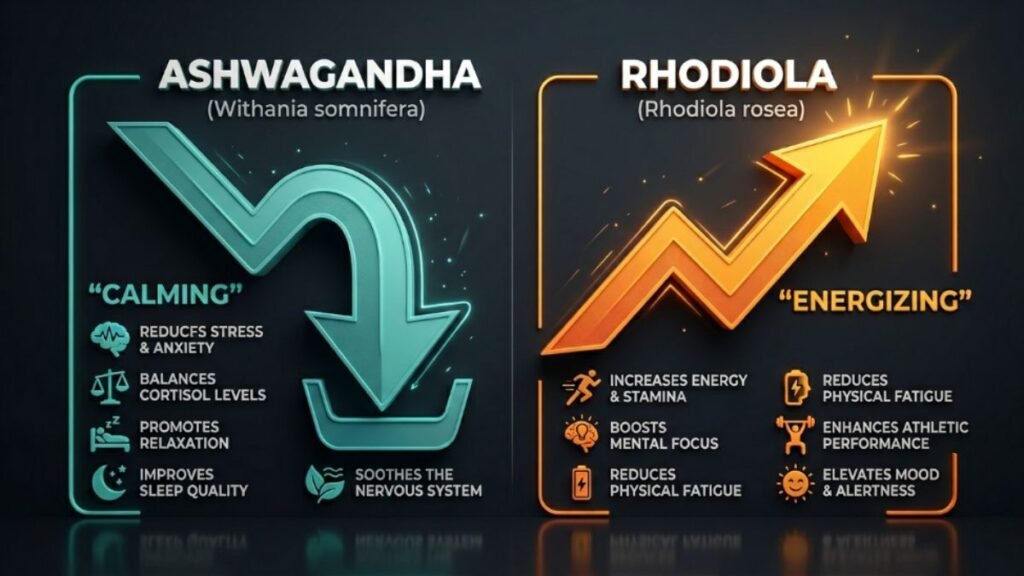
Both ashwagandha and rhodiola are classified as adaptogens — plants that help the body resist and recover from stress by nudging the HPA axis back toward balance. That shared category is why they get compared constantly. But their personalities are almost mirror images.
Ashwagandha is a down-regulator. It tends to calm an over-activated stress system. People describe it as taking the edge off — quieter mind, steadier mood, easier sleep. It’s the better fit when your fatigue feels anxious and “tired but wired.”
Rhodiola is an up-regulator. It tends to lift a flattened, depleted system. People describe it as restoring drive and mental stamina, often within hours. It’s the better fit when your fatigue feels flat, unmotivated, and foggy rather than anxious.
| Ashwagandha | Rhodiola | |
|---|---|---|
| Direction | Calming / down-shifting | Activating / lifting |
| Best for | “Wired but tired,” anxious fatigue | Flat, burned-out, low-drive fatigue |
| Onset | Builds over 2–6 weeks | Often felt within 1–2 hours |
| Best time | Evening or split AM/PM | Morning or early afternoon |
| Standout effect | Lower cortisol, better sleep | Reduced fatigue, mental stamina |
| Watch-out | Can feel sedating for some | Can feel stimulating; avoid late in day |
If you only remember one line from this comparison, make it this: ashwagandha pulls you down toward calm; rhodiola pulls you up toward energy. The right choice depends entirely on which direction your fatigue needs to move.
What the Research Actually Shows on Ashwagandha
Ashwagandha (Withania somnifera) is one of the most-studied adaptogens in modern clinical trials, and the strongest evidence sits squarely in the stress-and-cortisol lane.
A 2025 systematic review and meta-analysis of ashwagandha trials pooled 15 randomized controlled studies covering more than 870 adults and found that supplementation significantly reduced measures of stress and anxiety compared with placebo. Individual trials have also linked standardized extracts to meaningful drops in morning cortisol — the hormone most associated with that “running on adrenaline” exhaustion.
What that means in practice: ashwagandha is most useful when your mental fatigue is driven by stress and poor sleep. By helping quiet an overactive stress response, it can make the difference between lying awake replaying the day and actually recovering overnight — and recovered sleep is half the battle with mental fatigue in the first place.
A few realistic expectations. Ashwagandha is not a stimulant and won’t deliver a same-day jolt. Most trials use standardized root extracts (commonly KSM-66 or Sensoril, ideally above 5% withanolides) at roughly 300–600 mg per day, with benefits building over two to six weeks of consistent use. Because it leans calming, many people prefer it in the evening. If your fatigue is low energy rather than high stress, ashwagandha may make you feel more relaxed without actually feeling more awake — which brings us to its counterpart.
What the Research Actually Shows on Rhodiola
Rhodiola rosea is the adaptogen people reach for when the problem is depletion, not agitation — burnout, low motivation, and the kind of fog that settles in after a long stretch of overwork.
The evidence here is genuinely promising but more mixed than ashwagandha’s. A systematic review of rhodiola for physical and mental fatigue examined 11 controlled trials and found that three of five studies testing mental fatigue reported benefit, while noting that methodological flaws across the literature make firm conclusions difficult. In other words: encouraging signal, imperfect proof. It’s an honest picture worth keeping in mind before expecting miracles.
Where rhodiola stands out is speed and feel. Unlike ashwagandha’s slow build, many people notice rhodiola’s anti-fatigue and focus effects within one to two hours, which is why it’s often used situationally before a demanding morning. Effective extracts are typically standardized to 3% rosavins and 1% salidroside, in the 200–400 mg range, taken earlier in the day. Because it leans activating, taking it late can interfere with sleep — the opposite of what you want.
So the comparison sharpens: if you’re anxious and overstimulated, ashwagandha. If you’re flat and under-powered, rhodiola. But before you buy either, two things matter more than the herb you pick.
How to Choose Between Them (and What to Look For)

Matching the herb to your fatigue type gets you most of the way. Use this quick filter:
- Your fatigue feels anxious, restless, “tired but wired,” with bad sleep → start with ashwagandha.
- Your fatigue feels flat, unmotivated, foggy, burned-out → start with rhodiola.
- You genuinely can’t tell → most people in this situation are dealing with the stress-driven type, so ashwagandha is the safer first test.
Then there’s quality, which quietly decides whether you feel anything at all. The supplement aisle is full of under-dosed adaptogens hidden inside vague “proprietary blends” that never disclose how much of each ingredient you’re actually getting. If you’re going to test a single adaptogen, the non-negotiables are a standardized extract (KSM-66 or Sensoril for ashwagandha; 3% rosavins / 1% salidroside for rhodiola), a transparent label that lists the exact dose, and ideally third-party testing. Skip anything that buries the dose. Learning to read these labels properly is a skill in itself — our guide on how to build a clean nootropic stack without stimulants walks through the same label-reading logic in more detail.
Affiliate Disclosure: This article contains affiliate links. If you click through and make a purchase, Cognitive Insight Lab may earn a small commission — at no extra cost to you. We only recommend products we have genuinely researched and believe may offer real value to our readers. Our editorial opinions are always our own.
Here’s the part most comparison articles leave out, though. Even the best-chosen, best-dosed adaptogen only addresses one of the two engines of fatigue. If you’ve matched the herb to your symptoms, bought a clean standardized extract, given it a fair few weeks — and you still hit the wall — it usually means your fatigue isn’t only a stress problem. It’s also a fuel problem. And that’s a layer worth understanding, because for some people a well-formulated cellular energy approach does more than any adaptogen ever could.
The Layer Neither Adaptogen Fixes
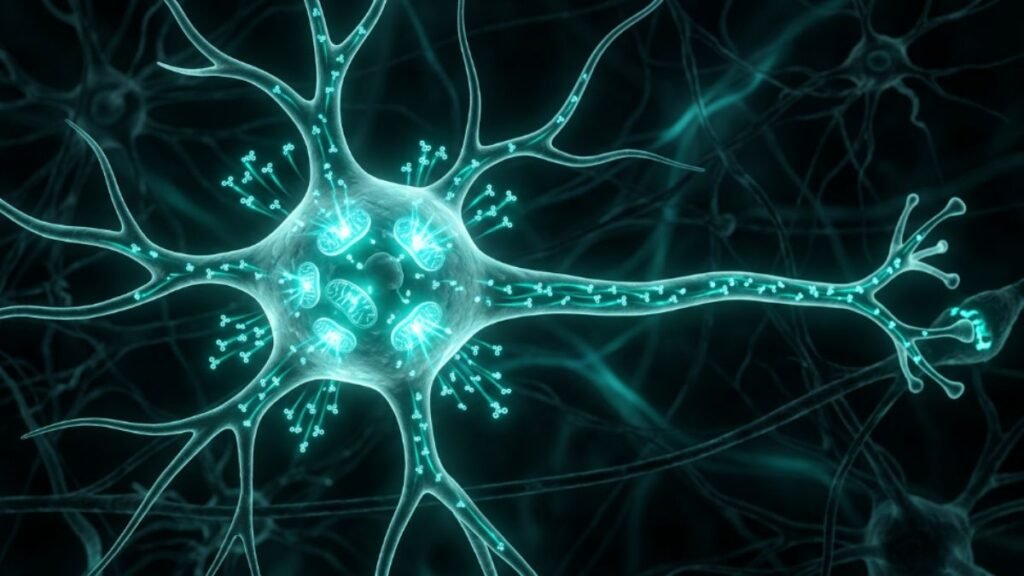
Adaptogens manage your response to stress. What they don’t do is refill the tank.
Remember the second engine of fatigue: ATP production inside your mitochondria. When that machinery slows down — from age, poor sleep, nutrient gaps, or simple chronic overload — your brain literally has less fuel to work with. No amount of cortisol balancing creates ATP that isn’t being made. This is the reason so many people describe doing “all the right things” for stress and still feeling foggy: they’ve been treating the stress layer and ignoring the fuel layer entirely.
This is also where the two strategies actually complement each other rather than compete. Adaptogens calm or lift the stress system; a stim-free cellular energy approach targets the mitochondria directly. The nutrients with the most support here aren’t herbs at all — they’re compounds like CoQ10, PQQ, and acetyl-L-carnitine (ALCAR), which help mitochondria produce and protect energy without touching caffeine or your stress hormones. Interestingly, rhodiola itself is thought to lend a hand on the mitochondrial side, which may be part of why it feels more “energizing” than ashwagandha in the first place.
If your mental fatigue has an energy-production component — and for most people over 40 chasing afternoon clarity, it does — then a stim-free formula built around CoQ10, PQQ, and ALCAR is the layer worth adding. Not as a replacement for sleep, stress management, or a well-chosen adaptogen, but as the missing piece those things can’t supply. If you want a ready-made version of that approach, that’s the formula I’d look at first. For a fuller picture of how chronic depletion takes hold and how to reverse it, our deep dive on the real causes of cognitive exhaustion connects the dots between stress, sleep, and cellular energy.
The supplements and approaches discussed here are not intended to diagnose, treat, cure, or prevent any condition. Persistent or worsening mental fatigue can have medical causes — including thyroid issues, anemia, sleep disorders, and depression — that supplements will not fix. If your fatigue is severe, sudden, or interfering with daily life, please speak with a qualified healthcare provider.
The Bottom Line
The ashwagandha vs rhodiola question has a cleaner answer than most articles admit: it comes down to the direction your fatigue needs to move. Choose ashwagandha when you’re anxious and “tired but wired,” and rhodiola when you’re flat, foggy, and depleted — both in clean, standardized, properly dosed forms.
But the most useful takeaway is the one that reframes the whole question. Adaptogens fix the stress layer of mental fatigue, not the fuel layer. If you’ve matched the right herb to your symptoms and still feel the wall coming at 2 p.m., the missing piece is almost always cellular energy — and that’s a fix neither plant can provide.
Start with the adaptogen that fits your fatigue type. Then, if the fog lingers, address the engine underneath it. You now know exactly where to look.
Frequently Asked Questions
Can you take ashwagandha and rhodiola together?
Yes, and many people do. Because they pull in different directions — ashwagandha calming, rhodiola activating — they can balance each other when timed correctly: rhodiola in the morning, ashwagandha in the evening. Start one at a time, though, so you can tell what each is actually doing for you.
How long until ashwagandha or rhodiola starts working?
They’re very different here. Rhodiola is often felt within one to two hours and works well situationally. Ashwagandha builds gradually, with most benefits appearing after two to six weeks of daily use. Judging ashwagandha after a single dose is the most common mistake people make.
Which is better for anxiety-related fatigue?
Ashwagandha. Its strongest evidence is in reducing stress and cortisol, making it the better fit for fatigue that feels anxious, restless, and sleep-disrupting. Rhodiola can feel too stimulating if anxiety is your main issue.
Are there side effects?
Both are generally well tolerated. Ashwagandha can feel sedating and may not suit people with certain thyroid or autoimmune conditions. Rhodiola can feel overstimulating, especially late in the day. Adaptogens can also interact with medications, so check with your doctor before starting — particularly if you’re pregnant, nursing, or managing a health condition.
Can adaptogens fix mental fatigue on their own?
Often, no. Adaptogens address the stress-driven layer of fatigue but not the cellular-energy layer powered by your mitochondria. If fatigue persists despite a well-chosen adaptogen, the missing piece is usually energy production — which is why a stim-free cellular energy approach is frequently the more complete strategy.
What’s the best time of day to take each?
Take rhodiola in the morning or early afternoon, since it’s activating and can disrupt sleep if taken late. Take ashwagandha in the evening, or split into morning and evening doses if your stress runs all day.
When should mental fatigue prompt a doctor visit?
If fatigue is severe, comes on suddenly, keeps getting worse, or comes with other symptoms like unexplained weight change, low mood, or shortness of breath, see a healthcare provider. These can signal underlying conditions that supplements won’t address.

Daniel Mercer é um escritor de ciências da saúde especializado em desempenho cognitivo, nootrópicos e pesquisas sobre saúde cerebral. Com formação em ciências biomédicas e mais de uma década de experiência revisando literatura clínica sobre desempenho mental e suplementação, ele fundou o Cognitive Insight Lab para simplificar informações irrelevantes e fornecer análises baseadas em evidências para pessoas que levam a sério sua saúde cognitiva. Daniel não aceita conteúdo patrocinado e não possui vínculos financeiros com as marcas analisadas neste site.