
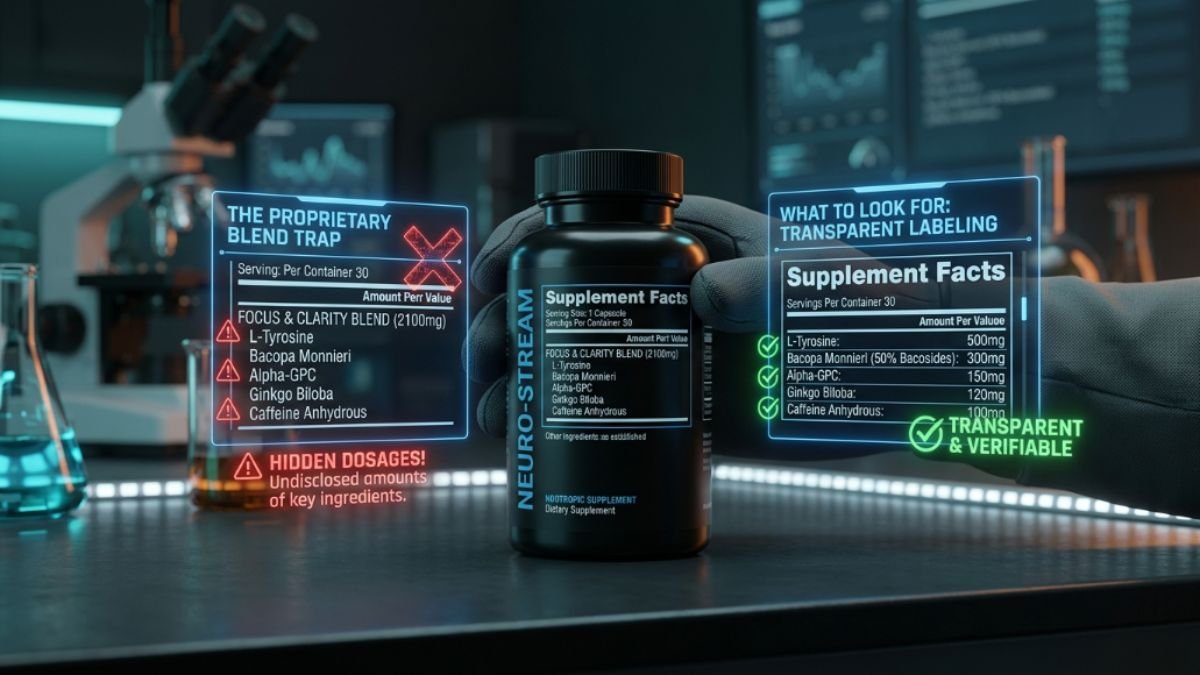
How to Read a Nootropic Label Without Being Fooled by Proprietary Blends
Learning how to read a nootropic label is the single most useful skill you can develop before spending a dollar on any brain supplement. It separates the people who get results from the people who burn through bottle after bottle wondering why nothing changed. And here’s the uncomfortable part: most labels in this space are designed — legally — to keep you from doing exactly that.
If you’ve ever stood in front of a shelf (or a checkout page) staring at a wall of impressive-sounding ingredients and had no real way to tell whether the product was worth $19 or $69, you’re not missing some secret knowledge. You’re running into a labeling loophole that an estimated majority of supplement products use to their advantage.
A 2023 analysis of the NIH’s Dietary Supplement Label Database found that up to 87% of the more than 155,000 labels reviewed could legally contain undisclosed ingredient amounts.
This guide walks you through how to read a nootropic label the way a formulator would — what to ignore, what actually matters, and the one number that tells you whether a product is built to work or built to sell.
This content is for informational and educational purposes only. It does not constitute medical advice. Please consult your healthcare provider before making changes to your diet, supplements, or cognitive health routine.
Why Most Nootropic Labels Are Built to Confuse You

Walk through the marketing for any brain supplement and you’ll see the same playbook. A long list of recognizable ingredients. Words like “clinically studied” and “research-backed.” A bold front label promising sharper focus and a clearer mind.
What you almost never see, front and center, is the one thing that determines whether any of it works: how much of each ingredient is actually in the capsule.
This isn’t an accident. An ingredient can be present in a formula at a dose far too small to do anything a study ever measured — a practice sometimes called “fairy dusting.” The ingredient name earns a spot on the label and in the ad copy. The dose does nothing. And unless you know what to look for, the label gives you no way to tell the difference.
The good news is that once you understand the structure of a supplement label, the confusion disappears. The information you need is almost always there — or its absence tells you everything.
What a “Proprietary Blend” Actually Is (And Why It’s Legal)
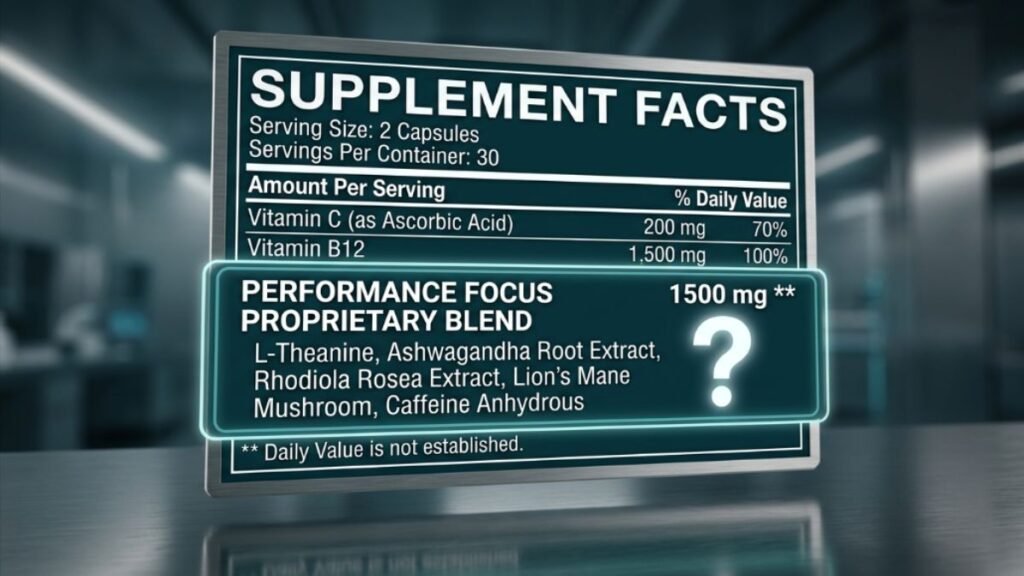
The term you need to recognize first is proprietary blend.
Under the Dietary Supplement Health and Education Act of 1994 (DSHEA), U.S. manufacturers are allowed to group several ingredients together under a single name — a “Proprietary Blend,” “Focus Matrix,” “Cognitive Complex,” or any fanciful term they choose. According to the FDA’s labeling rules, the company must disclose the total combined weight of the blend and list the ingredients inside it in descending order by weight.
Read that again, because it’s the whole game. A label can say “Cognitive Blend — 600 mg” and list eight ingredients underneath it, and you have no way of knowing whether the first ingredient is 550 mg or 50 mg. The remaining seven could be little more than a sprinkle.
This allowance exists to protect a manufacturer’s formula as a trade secret. That’s the official justification, and it’s a legitimate one for some companies. But in practice, the proprietary blend has become the most reliable place for a brand to hide underdosed, cheap, or clinically meaningless amounts behind a name that sounds substantial.
The takeaway: a proprietary blend is not automatically a scam. But it does remove your single most important evaluation tool — the dose — and that should always make you more cautious, not less.
The One Number That Tells You Everything: The Dose
Here’s the principle that cuts through all the marketing. An ingredient only does what the research says it does at the dose the research used. Below that dose, you’re often paying for a name on a label and nothing more.
That’s why dose transparency matters more than the length of the ingredient list, the quality of the website, or the number of testimonials. A short formula with five fully disclosed, properly dosed ingredients will almost always outperform a fourteen-ingredient “mega blend” where you can’t verify a single amount.
When you can see every dose, you can do something powerful: compare it against the ranges used in published studies. When you can’t, you’re trusting the brand’s marketing — and the brands most worth trusting are the ones that don’t ask you to.
How to Read a Nootropic Label: A Step-by-Step Method
Here’s the exact sequence to run every time you evaluate a brain supplement. It takes about ninety seconds once it becomes habit.
Step 1 — Find the Supplement Facts panel
Ignore the front of the bottle entirely. The front is advertising. Flip to the Supplement Facts panel — the boxed nutrition-style table. Everything that matters lives here.
Step 2 — Scan for the words “Proprietary Blend”
Look for any grouped ingredients sitting under a single total weight, often marked with a descriptive or branded name. If you see one, mentally flag every ingredient inside it as “dose unknown.” You can no longer evaluate those ingredients individually — and that’s a meaningful limitation.
Step 3 — Check each dose against studied ranges
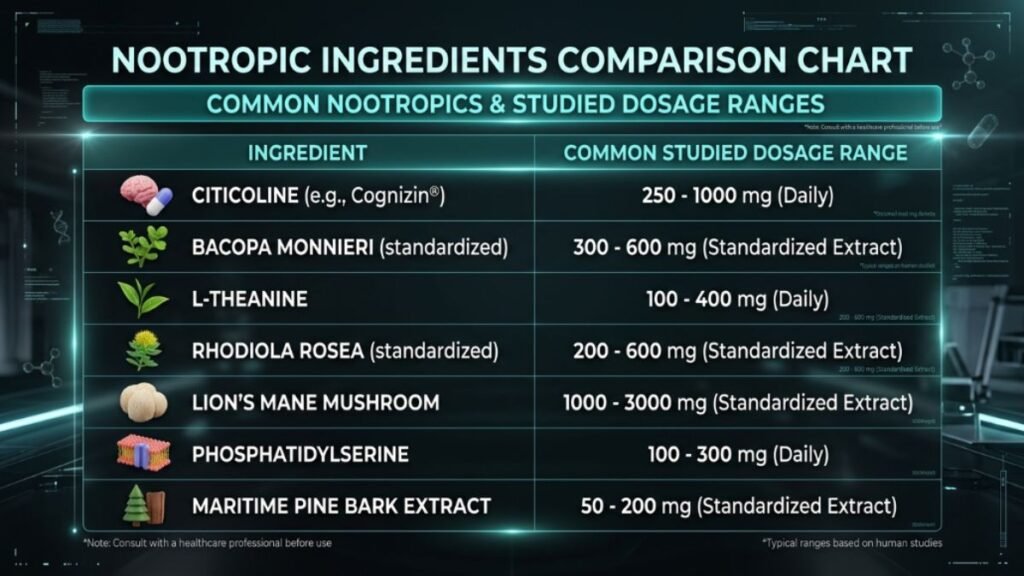
For a fully transparent label, you’ll see an amount next to every ingredient. This is where you earn your results. Compare those amounts to the doses used in research. The table below gives you commonly cited ranges for popular nootropic ingredients as a starting reference.
These ranges are general reference points, not prescriptions. Effective doses vary by individual, age, formulation, and the specific extract used, and research in this field is still evolving. Treat the table as a way to spot doses that are obviously too low — not as a guarantee that a “correct” dose will work for you.
Step 4 — Read the “Other Ingredients” line
Below the Supplement Facts panel, the “Other Ingredients” line lists the capsule material, fillers, binders, and flavorings. A clean formula keeps this short. A long list of artificial additives, unnecessary fillers, or a cheap capsule shell is a small but telling signal about the company’s priorities.
Step 5 — Look for third-party testing
Finally, check whether the product is verified by an independent lab or program (third-party tested, GMP-certified facility, or a quality seal). This doesn’t tell you whether the doses are effective, but it does tell you whether what’s on the label is actually what’s in the bottle — a separate and important question.
Red Flags vs. Green Flags at a Glance
Once you’ve run the steps a few times, the patterns become obvious. Here’s the shortcut:
| 🚩 Red flags | ✅ Green flags |
|---|---|
| “Proprietary blend” hiding individual doses | Every ingredient dose fully disclosed |
| Huge ingredient list, no amounts shown | Focused formula with researched doses |
| “Clinically studied” with no dose to verify | Doses that match published research |
| No mention of testing or sourcing | Third-party tested, standardized extracts |
| Hype-heavy front label, vague back panel | Quiet front, detailed Supplement Facts |
If you’re still building a sense of which ingredients are worth looking for in the first place, our guide to the best nootropics for focus breaks down the individual compounds with the strongest evidence behind them. And if your main issue is mental fog rather than raw focus, the criteria shift slightly — we cover that in how to choose a nootropic stack for brain fog.
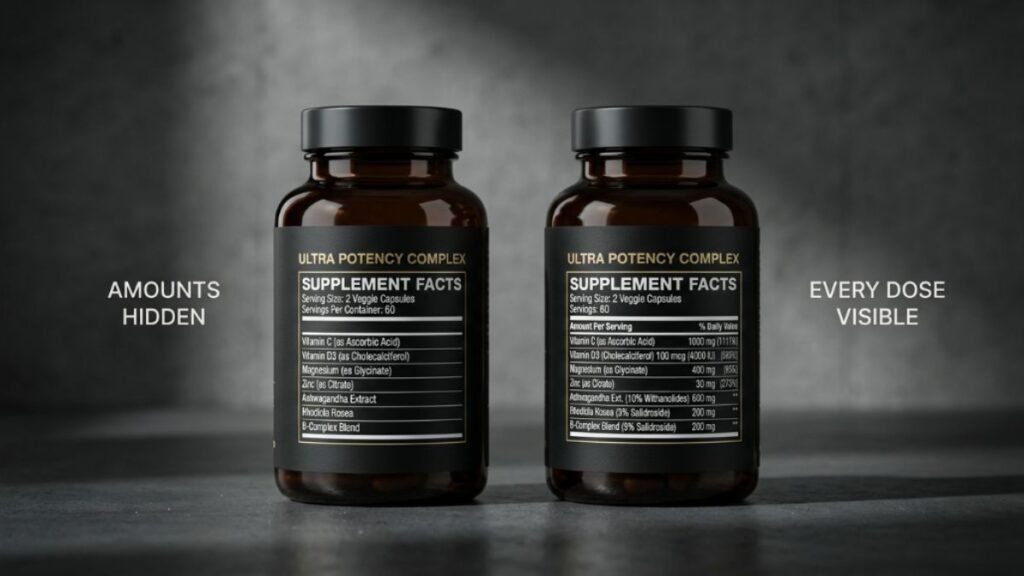
What a Genuinely Transparent Label Looks Like
Affiliate Disclosure: This article contains affiliate links. If you click through and make a purchase, Cognitive Insight Lab may earn a small commission — at no extra cost to you. We only recommend products we have genuinely researched and believe may offer real value to our readers. Our editorial opinions are always our own.
So what does a label look like when a company has nothing to hide?
It shows every ingredient with its exact amount. No blend names, no grouped totals, no asterisks doing the heavy lifting. You can take each dose, hold it up against the research ranges above, and decide for yourself whether the formula is serious.
To make this concrete, it helps to look at a formula that’s built on this principle. One of the most-cited examples in the category discloses all eleven of its ingredients with exact doses on the label — Citicoline at 250 mg, Phosphatidylserine at 100 mg, Bacopa Monnieri at 150 mg, Lion’s Mane at 500 mg, L-Theanine at 100 mg, and so on, with no proprietary blend anywhere on the panel. It’s also been put through double-blind, placebo-controlled human trials at the University of Leeds, with results published in peer-reviewed journals.
Notice what that lets you do. You can see that the Bacopa dose, for example, sits below the 300 mg often used in memory studies — and decide whether that trade-off matters to you. That’s not a weakness of the label. That’s the entire point. A transparent label hands you the information and trusts you to judge it. A proprietary blend takes that judgment away.
If you want a starting point that already passes every test in this guide — full dose disclosure, standardized extracts, third-party testing, and published human research — this is the kind of formula worth looking at first.
See a Fully Transparent Nootropic Label → HERE
It isn’t the cheapest option on the shelf, and it won’t be right for everyone. But it’s a clean example of what you’re now equipped to look for on your own — on any label, from any brand.
Conclusion
Reading a nootropic label well comes down to three habits. First, ignore the front of the bottle and go straight to the Supplement Facts panel. Second, treat any “proprietary blend” as a dose you can’t verify, and weigh that accordingly. Third, compare disclosed amounts against studied ranges so you know whether you’re buying a real dose or a name on a list.
You don’t need to memorize the research. You just need to insist on seeing it. The brands worth your money are the ones that show their work — and now you know exactly where to look.
This content is for informational and educational purposes only. It does not constitute medical advice. Brain fog, memory changes, and persistent concentration problems can have underlying medical causes. Please consult a qualified healthcare provider before starting any supplement, especially if you take medication or have a health condition.
FAQ about How to Read a Nootropic Label
What does “proprietary blend” mean on a supplement label?
It’s a group of ingredients listed under a single name and total weight, where the individual amount of each ingredient is not disclosed. It’s legal under U.S. law and can protect a genuine trade secret, but it also makes it impossible to verify whether any single ingredient is present at an effective dose.
Are proprietary blends always a bad sign?
Not always — some reputable companies use them. But because they hide individual doses, they remove your main tool for evaluating a formula. As a rule, a fully transparent label gives you more to work with and is easier to trust.
How do I know if a nootropic dose is high enough to work?
Compare the amount on the label to the doses used in published research for that ingredient. If the label hides the dose inside a blend, you can’t make that comparison at all — which is reason enough to be cautious.
Is a longer ingredient list better?
No. A short, fully dosed formula usually outperforms a long list where amounts are hidden or spread too thin. Quality and dosing matter far more than quantity of ingredients.
Does third-party testing mean the doses are effective?
No. Third-party testing confirms that the product contains what the label claims and is free of contaminants. It’s important for safety and accuracy, but it’s a separate question from whether the doses are large enough to produce results.
Are nootropic supplements safe?
Most well-formulated, stimulant-free nootropics are generally well tolerated, but “natural” does not mean risk-free. Ingredients can interact with medications and affect people differently. Always check with a healthcare provider before starting, particularly if you’re pregnant, nursing, or managing a medical condition.
When should brain fog be checked by a doctor instead of treated with supplements?
If brain fog or memory problems are sudden, severe, worsening, or interfering with daily life, they warrant medical evaluation. Persistent cognitive symptoms can stem from sleep disorders, thyroid issues, nutrient deficiencies, or other treatable conditions that no supplement will fix.

Daniel Mercer é um escritor de ciências da saúde especializado em desempenho cognitivo, nootrópicos e pesquisas sobre saúde cerebral. Com formação em ciências biomédicas e mais de uma década de experiência revisando literatura clínica sobre desempenho mental e suplementação, ele fundou o Cognitive Insight Lab para simplificar informações irrelevantes e fornecer análises baseadas em evidências para pessoas que levam a sério sua saúde cognitiva. Daniel não aceita conteúdo patrocinado e não possui vínculos financeiros com as marcas analisadas neste site.