

How Long Bacopa Takes to Work: The Real 12-Week Timeline
If you’ve started taking Bacopa and you’re quietly wondering how long Bacopa takes to work, you’ve probably already noticed the uncomfortable truth: at week two, most people feel absolutely nothing. That silence is exactly where most Bacopa experiments quietly die.
Here’s the part the supplement labels rarely make obvious. Bacopa monnieri is one of the few botanical nootropics with a genuinely strong evidence base — but nearly every well-designed human trial ran for a minimum of twelve weeks. A meta-analysis pooling nine randomized controlled trials and 518 participants only included studies that dosed Bacopa for twelve weeks or longer, because that’s the window where measurable cognitive change actually shows up.
So the frustration you might be feeling isn’t a sign the supplement is failing. It’s a sign you’re inside the normal, biologically expected lag. This article lays out the real timeline week by week, explains why Bacopa works on a slower clock than stimulants, and shows you the handful of factors that decide whether you get results at the end of those twelve weeks — or waste them.
This content is for informational and educational purposes only. It does not constitute medical advice. Please consult your healthcare provider before making changes to your diet, supplements, or cognitive health routine.
The Short Answer on How Long Bacopa Takes to Work

For most adults, Bacopa takes roughly eight to twelve weeks of consistent daily use before meaningful cognitive effects become noticeable. Some early signals can appear sooner, but the full benefit — better delayed recall, faster learning, steadier attention — accumulates gradually.
This is not marketing caution. It’s what the research repeatedly shows. In one randomized controlled trial of standardized Bacopa extract in adults with age-associated memory impairment, researchers tested participants at weeks 4, 8, and 12. The improvements didn’t arrive all at once. A measurable gain in logical memory appeared around week 4, broader gains in mental control and paired-associate learning emerged by week 8, and the fullest effect landed at week 12.
That staggered pattern is the single most useful thing to understand about Bacopa. It doesn’t switch on. It builds.
Why Bacopa Doesn’t Work Like a Stimulant

If you’ve ever taken caffeine or a stimulant-based focus product, you’ve been trained to expect a fast, obvious signal — alertness within thirty minutes. Bacopa breaks that expectation completely, and the reason is mechanistic.
Stimulants work by temporarily flooding your system with a chemical signal. The effect is immediate and the effect fades. Bacopa does something structurally different. Its active compounds — bacosides A and B — influence the brain in ways that take time to compound.
First, Bacopa modulates acetylcholine, the neurotransmitter most tightly linked to working memory and sustained attention, partly by slowing the enzyme that breaks acetylcholine down. A 12-week trial in healthy older adults found that standardized Bacopa extract improved working memory while measurably suppressing that breakdown enzyme — a change that strengthens over weeks of dosing, not hours.
Second, Bacopa supports dendritic branching — the physical extension of connections between neurons. This is the cellular machinery behind memory consolidation, and it operates on a biological timescale. You cannot rush the growth of neural connections any more than you can rush the growth of a muscle.
Third, Bacopa reduces oxidative stress in the hippocampus, the brain’s memory hub. This protective effect is cumulative, not instant.
Put together, this is why how long Bacopa takes to work is measured in weeks. You’re not waiting for a chemical hit. You’re waiting for slow structural change.
The Week-by-Week Reality
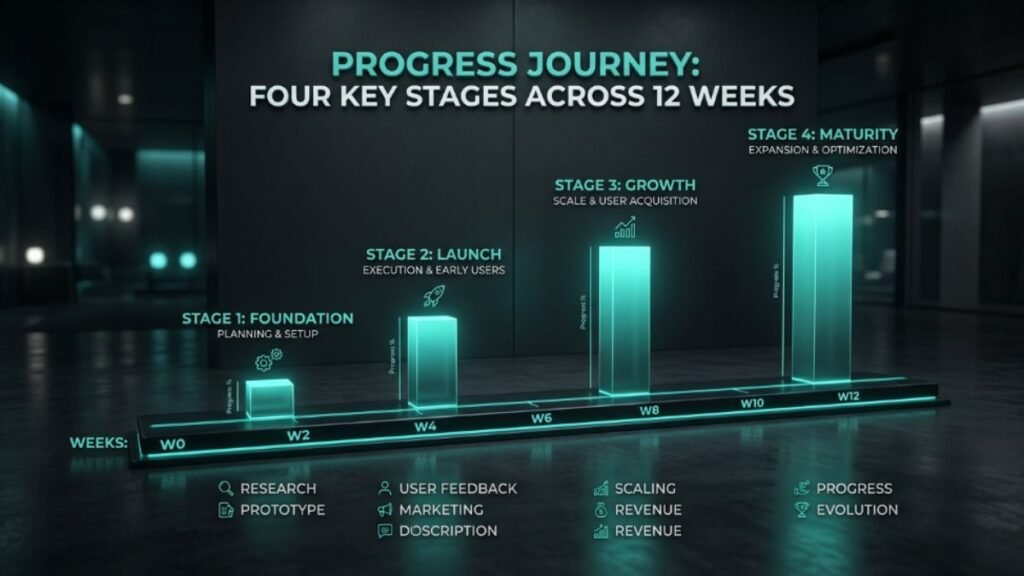
Here’s a realistic map of what the twelve weeks tend to look like, drawn from the clinical timelines rather than from anecdote.
| Phase | What’s happening | What you might notice |
|---|---|---|
| Weeks 1–2 | Bacosides begin accumulating; no structural change yet | Usually nothing. Possibly mild stomach sensitivity if taken without food |
| Weeks 3–4 | Acetylcholine modulation takes hold; first measurable signals in trials | Subtle: a word that comes back faster, slightly easier recall |
| Weeks 5–8 | Consolidation effects compound; mental control and learning improve in studies | Clearer: information you study seems to “stick” better the next day |
| Weeks 9–12 | Fullest effect; delayed recall gains most pronounced | Most noticeable improvement in retaining and retrieving information |
The most important row in that table is the first one. Weeks 1 and 2 are where people give up — and they give up precisely because the supplement is doing exactly what the science predicts it will do at that stage, which is to say, not much you can feel yet.
It’s also worth knowing what Bacopa tends to improve. A placebo-controlled study using delayed recall as its primary measure found that participants taking standardized Bacopa for twelve weeks showed enhanced ability to retrieve information after a delay — the exact cognitive function that brain fog so often steals. Bacopa is not a focus stimulant. It’s a memory-consolidation tool that needs a full runway.
If you’re still in the early stages and questioning whether any of this is worth it, our guide on what to look for in a memory supplement after 40 explains why the slowest-acting ingredients are often the ones with the strongest long-term evidence.
What Actually Affects Your Timeline

Two people can start Bacopa on the same day and reach week twelve with completely different results. The difference usually comes down to a few controllable factors.
Dose and standardization. The trials that showed results used standardized extracts, typically in the range of 300mg per day, standardized to a defined percentage of bacosides. A product that lists “Bacopa” without specifying the bacoside content is a gamble — you have no way of knowing whether you’re getting a clinical dose or a sprinkle.
Taking it with food. Bacopa’s active compounds are fat-soluble. Taking it with a meal that contains some fat improves absorption and dramatically reduces the mild nausea that’s its most common side effect.
Consistency. This is the one that decides everything. Bacopa works through accumulation. Skipping days resets the very gradual build you’re trying to create. The twelve-week clock only runs when you take it daily.
Your baseline. Adults dealing with stress-driven cognitive fog, or those starting from a lower cognitive baseline, often notice clearer changes than someone already operating at peak. This is consistent across the literature — the people with the most room to improve tend to see the most movement. It’s also worth being honest about the source of your fog: if your symptoms are driven mainly by chronic stress and mental fatigue rather than pure memory decline, a memory-consolidation herb may not be the most direct lever. Our comparison of adaptogens for mental fatigue breaks down where stress-targeted options fit versus where a tool like Bacopa is the better match — because matching the ingredient to the actual problem is half the battle.
For a broader look at how this fits the full picture of mental clarity, our overview of the best supplements for brain fog places Bacopa alongside the other evidence-backed options and explains where each one fits.
The Mistake That Wastes the Twelve Weeks
Here’s the trap. Most people who “tried Bacopa and it didn’t work” fall into one of three groups: they quit before week 4, they took an under-dosed or non-standardized product, or they took Bacopa in isolation and expected it to do everything.
That last point matters more than it seems. Bacopa is excellent at memory consolidation, but cognitive performance isn’t a single dial. Attention, mental energy, and processing speed run on other systems entirely. Asking one botanical to carry all of that — for twelve patient weeks — is setting it up to disappoint.
This is why the most reliable approach isn’t a single isolated ingredient at an unknown dose. It’s a fully standardized formula that includes a clinically meaningful Bacopa dose alongside compounds that cover the functions Bacopa doesn’t — so the twelve weeks you’re investing actually pay off across the board, not just in one narrow lane.
Affiliate Disclosure: This article contains affiliate links. If you click through and make a purchase, Cognitive Insight Lab may earn a small commission — at no extra cost to you. We only recommend products we have genuinely researched and believe may offer real value to our readers. Our editorial opinions are always our own.
Giving Bacopa a Fair Trial
If you’re going to commit twelve weeks of your life and attention to this, it’s worth doing it on terms that give Bacopa an honest chance to show what it can do.
That means a standardized dose you can actually verify, taken daily, with food, for the full window — not a guess from an unlabeled bottle abandoned at week three. It also means pairing Bacopa’s slow memory work with the other pieces of cognition, so you’re not left wondering whether the lack of an energy boost means the supplement “isn’t working” when energy was never Bacopa’s job.
For most people researching this seriously, the cleanest way to do that is a stimulant-free stack built around this exact biology — clinically dosed, fully transparent on its label, and designed to be evaluated over weeks rather than judged in days. If you want a ready-made way to run a fair twelve-week trial, that’s where most informed readers start.
This content is for informational and educational purposes only. It does not constitute medical advice. Persistent brain fog, memory loss, or concentration problems can occasionally signal an underlying medical condition. If your symptoms are severe, worsening, or new, please consult a qualified healthcare provider before beginning any supplement protocol.
Conclusion
How long Bacopa takes to work is the question that quietly determines whether you ever benefit from it. The honest answer — eight to twelve weeks, building gradually — is also the answer that protects you from quitting too early.
Three things to hold onto: feeling nothing in the first two weeks is normal and expected, not a failure; dose, standardization, consistency, and taking it with food decide your outcome; and Bacopa rewards patience with exactly one thing — better memory consolidation, on its own slow clock.
Give it a fair, full, properly dosed twelve weeks, and you’ll actually know whether Bacopa belongs in your routine — instead of guessing from a trial that never had a chance.
Frequently Asked Questions
How long does Bacopa take to work?
For most adults, meaningful effects appear after eight to twelve weeks of consistent daily use. Some subtle signals can show up around week four, but the fullest benefit — particularly for delayed recall — accumulates over the full twelve-week window seen in clinical trials.
Why do I feel nothing after two weeks of Bacopa?
Because that’s biologically normal. Bacopa works through gradual structural changes like dendritic branching and acetylcholine modulation, not a fast chemical hit. The first two weeks are accumulation; noticeable change typically begins around week four and builds from there.
Can you speed up how long Bacopa takes to work?
You can’t shortcut the biology, but you can avoid slowing it down. Use a standardized dose, take it daily without skipping, and take it with a meal containing some fat to improve absorption. Inconsistency is the most common reason the timeline stretches out or stalls.
Does Bacopa work immediately for anyone?
No. Unlike caffeine or stimulant-based products, Bacopa produces no acute, same-day effect. Anyone reporting an instant boost is likely responding to other ingredients in a combined formula, not to Bacopa itself.
Is it safe to take Bacopa daily for twelve weeks?
Standardized Bacopa is generally well tolerated in studies running twelve weeks or longer, with mild digestive discomfort being the most commonly reported effect — usually resolved by taking it with food. As with any supplement, consult your healthcare provider first, especially if you take medications or have existing health conditions.
Should I take Bacopa in the morning or at night?
Timing matters less than consistency. Because Bacopa isn’t a stimulant, it won’t disrupt sleep, so either works. The key is taking it at the same time daily, with food, so the gradual twelve-week build is never interrupted.

Daniel Mercer é um escritor de ciências da saúde especializado em desempenho cognitivo, nootrópicos e pesquisas sobre saúde cerebral. Com formação em ciências biomédicas e mais de uma década de experiência revisando literatura clínica sobre desempenho mental e suplementação, ele fundou o Cognitive Insight Lab para simplificar informações irrelevantes e fornecer análises baseadas em evidências para pessoas que levam a sério sua saúde cognitiva. Daniel não aceita conteúdo patrocinado e não possui vínculos financeiros com as marcas analisadas neste site.