
Natural Dopamine and Focus: How to Boost Your Brain’s Motivation System
Natural dopamine and focus is the quiet engine behind almost everything you mean to get done and somehow don’t. It’s the chemistry that decides whether opening your laptop feels like a small reasonable step or an immovable wall. When it’s working, focus arrives without a fight. When it’s running thin, you can want to concentrate with everything you have and still find yourself reaching for your phone instead.
Most people treat focus as a willpower problem. It usually isn’t. It’s a signaling problem, and the signal in question is dopamine — the neurotransmitter your brain uses to decide what’s worth pursuing. The good news is that you have far more influence over that signal than the productivity advice you’ve been sold would suggest. The bad news is that almost everything about modern daily life is engineered to spend it faster than you can rebuild it.
What follows is a grounded look at how dopamine drives focus, the everyday habits that quietly deplete it, and the practical levers that help restore a steadier baseline.
Disclaimer: This content is for informational purposes only and is not a substitute for professional medical advice. Always consult a qualified healthcare provider before acting on any recommendations.
What Dopamine Actually Does for Focus and Motivation
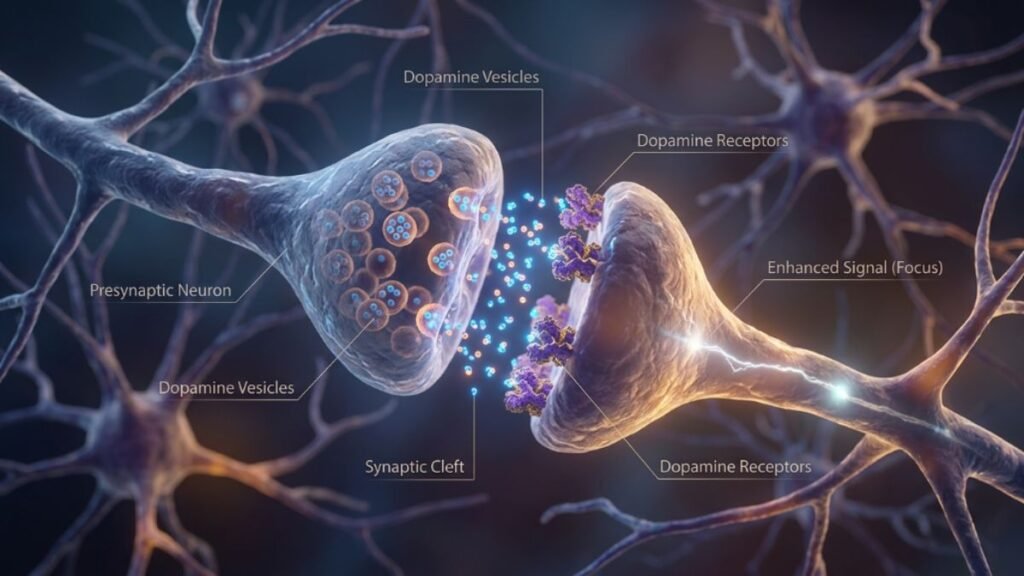
Dopamine gets described as the “pleasure chemical,” and that label is mostly wrong. It’s closer to the brain’s bookkeeper for effort. It tags certain actions as worth the energy and nudges you toward them, then keeps you on task long enough to finish. According to Cleveland Clinic, dopamine is central to motivation, attention, mood, and movement, and it’s built from the amino acid tyrosine that comes from the food you eat.
The distinction matters more than it sounds.
Dopamine Is About the Pursuit, Not Just the Reward
Researchers have largely moved away from the idea that dopamine simply makes you feel good. The current view is that dopamine confers what neuroscientists call motivational salience: it marks something as important enough to chase. That’s why a person with healthy dopamine signaling can start a boring task and stay with it, while someone running low knows exactly what they should be doing and still can’t make themselves begin.
Focus, in other words, is downstream of motivation. You can’t white-knuckle your way past a flat signal for long. You have to address the signal itself.
Why Modern Life Drains Your Baseline
Your brain calibrates. When it gets used to large, fast hits of dopamine, ordinary tasks start to feel duller by comparison. A morning of rapid scrolling, sugary snacks, and constant notifications trains the system to expect intensity, and a quiet spreadsheet simply can’t compete. The result is a kind of motivational static: everything important feels slightly out of reach, and only the cheap, stimulating stuff feels easy.
This is why “just focus harder” rarely works. The problem isn’t your discipline. It’s that your reward system has been recalibrated against you.
Signs Your Dopamine System Is Running Low
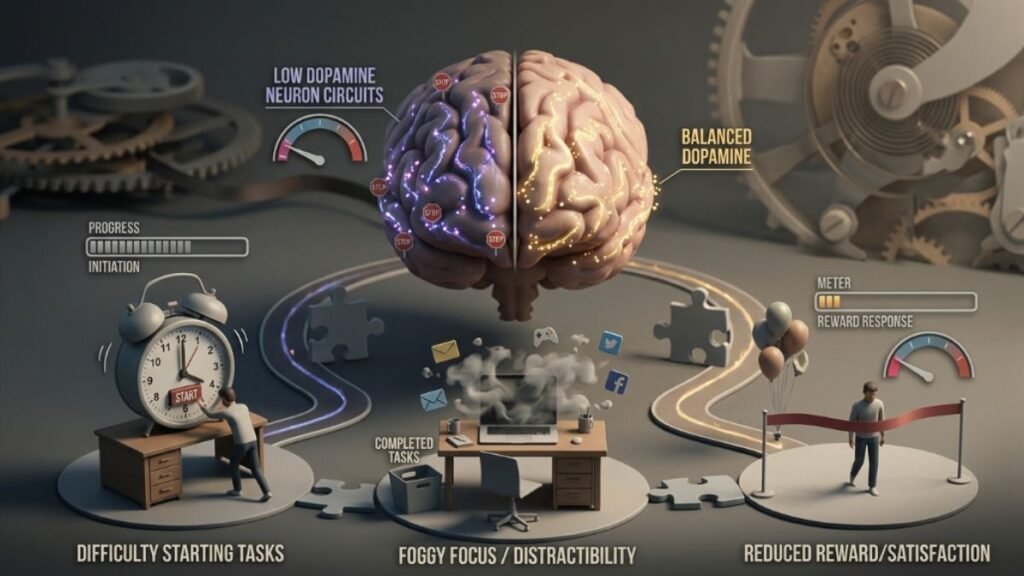
There’s no home test for dopamine, and the symptoms overlap with plenty of other things, so treat the list below as a pattern to notice rather than a diagnosis. Still, when several of these show up together, low dopaminergic drive is a reasonable suspect:
- You know what to do but can’t get yourself to start
- Tasks that used to feel routine now feel disproportionately heavy
- Your motivation collapses in the early afternoon
- You reach reflexively for your phone, snacks, or anything stimulating between tasks
- Finishing things gives you less satisfaction than it used to
- Your mind feels flat rather than anxious — more “can’t be bothered” than “can’t calm down”
A useful real-world example: the project you’ve rescheduled four times isn’t necessarily the hardest thing on your list. Often it’s the thing your brain has stopped tagging as worth the effort, because every easier dopamine source got there first. If that afternoon flatness is your dominant pattern, it often has a mechanism of its own — the slow drain we cover in why decision fatigue wears down your focus.
How to Boost Natural Dopamine Through Daily Habits
This is where most of the leverage lives. None of these is a trick; they’re inputs your dopamine system genuinely depends on. Treat them as the foundation before you consider anything else. They also overlap heavily with the lifestyle habits that clear brain fog naturally, because the same systems drive both.
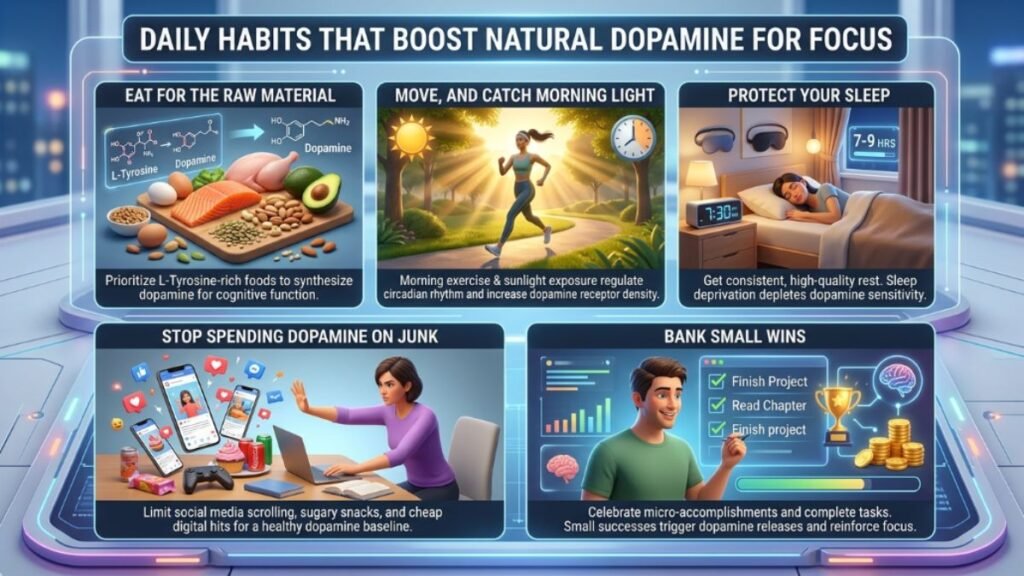
Eat for the Raw Material
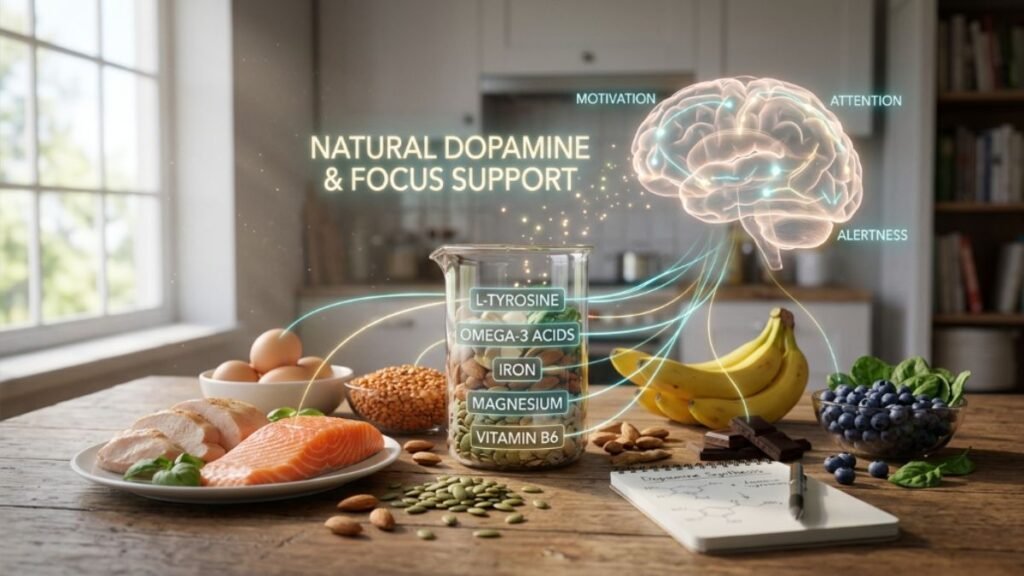
Dopamine is synthesized from tyrosine, and tyrosine comes from protein. If your meals are light on it, you’re asking your brain to build a neurotransmitter without enough of the ingredient. Tyrosine-rich foods include chicken, eggs, fish, dairy, soy, almonds, and pumpkin seeds, alongside leafy greens that supply supporting nutrients. You don’t need to obsess over individual foods — a steady supply of quality protein across the day does most of the work.
Move, and Catch Morning Light
Physical activity is one of the most reliable ways to support catecholamine activity, and it doesn’t require a punishing routine. A brisk walk counts. Pairing that movement with early daylight is even better, because morning light exposure helps anchor the daily rhythms that govern alertness and drive. Ten minutes outside before you open a screen is a small habit with an outsized return.
Protect Your Sleep
Sleep is not optional maintenance for this system. Research on sleep loss has linked chronic deprivation to measurable changes in dopamine receptor signaling, which helps explain why a poor night leaves you both foggy and strangely unmotivated. If you only fix one input on this list, make it this one.
Stop Spending Dopamine on Junk
The flip side of building dopamine is not blowing through it on cheap hits before your real work begins. You don’t need a dramatic “dopamine detox.” You need to stop front-loading your morning with the most stimulating possible inputs. Delay the phone. Keep the first hour low-stimulation. Let ordinary tasks have a fair chance to feel rewarding again.
Bank Small Wins
Completing something — anything — gives the system a legitimate signal that effort pays off. Starting your day with one genuinely finished task, however small, primes the pump for the harder work behind it. Momentum is not a personality trait. It’s a dopamine pattern you can deliberately build.
When Food and Habits Aren’t Enough: Targeted Nutrients
Habits come first, always. But there’s an honest case for targeted support, particularly during stretches of high cognitive load or stress, when your brain burns through neurotransmitters faster than usual.
The most discussed nutrient here is tyrosine, the direct precursor to dopamine. The evidence is genuinely mixed and worth understanding rather than overselling. A review of controlled human trials found that tyrosine supplementation can help offset declines in cognitive performance under stress or heavy mental demand, but that the benefit largely depends on whether your neurotransmitter function is already being taxed. Translation: it tends to help most when you’re depleted, and does little when you’re not. It is not a stimulant and it won’t manufacture motivation out of nothing.
A few other nutrients are commonly used to support the same goal from different angles:
| Nutrient | Role in focus and drive | What the research suggests | Honest caveat |
|---|---|---|---|
| L-Tyrosine | Direct dopamine precursor | May protect performance under stress or sleep loss | Effect depends on being depleted; mixed results otherwise |
| L-Theanine | Calm, steady attention | Smooths focus, especially paired with caffeine | Supports focus, not dopamine directly |
| Rhodiola Rosea | Mental fatigue resistance | Studied for stress-related tiredness | Quality and dose of extract vary widely |
| Citicoline | Attention and mental energy | Supports acetylcholine and brain energy | Works on a different pathway than dopamine |
The practical problem is that assembling these individually means buying several products, matching doses, and hoping they were formulated to work together. For people who’d rather not manage that, a single formula that combines these precursors with the cofactors the brain needs to use them can take the guesswork out of covering the basics. The principle still holds: support is only useful once the foundational habits are in place.
What no nutrient does is replace sleep, food, and movement. If those are broken, the most sophisticated stack on the market is patching a roof while the foundation floods.
Building a Realistic Focus Routine
Information only matters if it survives contact with a normal day. Here’s how the pieces fit together without turning your life into a protocol.
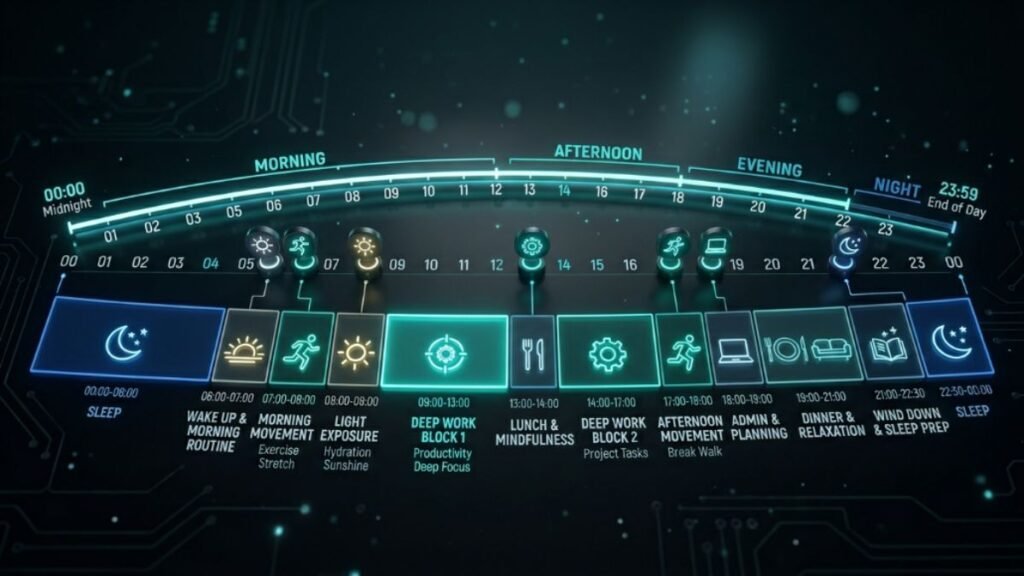
Start the morning low-stimulation and protein-forward. Get light and a little movement before the screen wins your attention. Do one small task to completion early, so the system gets an honest win. Save your most demanding focus work for the window when your energy is naturally highest, rather than after it’s already drained. And treat your evening wind-down as part of tomorrow’s focus, because the sleep you protect tonight is the motivation you’ll have at 10 a.m.
If you want a steadier baseline during a genuinely demanding season — exam weeks, a launch, a stretch of bad sleep you can’t fully fix yet — that’s the moment targeted support earns its place. For people who’d rather start from a covered foundation than build it piece by piece, an all-in-one approach built around these same focus-supporting nutrients can be a simpler entry point than chasing single ingredients.
The goal isn’t a perfect day. It’s a system that doesn’t quietly work against you.
Medical disclaimer: The information provided here is for educational purposes only and is not intended as medical advice, diagnosis, or treatment. Results vary from person to person. If you have a medical condition, take medication, or have any health concerns, consult a licensed healthcare professional before making changes to your routine or trying any supplement.
Frequently Asked Questions about Natural Dopamine and Focus
Can you really increase dopamine naturally?
You can support healthy dopamine signaling through diet, exercise, sleep, light exposure, and managing overstimulation. You’re not “raising a number” so much as keeping the system supplied and well-regulated. Lifestyle has a larger and more durable effect than most people expect.
What foods help the most?
Protein-rich foods supply tyrosine, the building block of dopamine. Chicken, eggs, fish, dairy, soy, almonds, and pumpkin seeds are solid choices, supported by leafy greens. Consistency across the day matters more than any single “superfood.”
Does a dopamine detox work?
Not in the literal sense — you can’t drain and reset the chemical on command. What does help is reducing constant high-stimulation inputs, like compulsive scrolling, so that ordinary tasks feel rewarding again. The useful idea is recalibration, not abstinence.
How long before I notice a difference?
Sleep and reduced overstimulation can shift how you feel within days. Dietary and movement habits build over a few weeks. Nutrient support, when it helps, tends to show up most clearly during periods of stress or high demand rather than as a dramatic daily change.
Are dopamine-support supplements safe?
Many common ingredients are well tolerated in typical doses, but “natural” does not mean risk-free, and quality varies enormously between products. Anything that affects brain chemistry deserves a conversation with your doctor first, especially if you take medication.
Is low motivation the same as low dopamine, ADHD, or depression?
No. Persistent low motivation, flat mood, or focus problems can stem from dopamine-related issues, but also from depression, ADHD, thyroid problems, sleep disorders, and more. If symptoms are significant or lasting, that’s a reason to see a professional, not to self-treat with supplements.
When is the best time to support dopamine?
Front-load the day. Morning light, movement, and protein set a better tone than trying to claw back focus in the afternoon. Protecting sleep at night is what makes the next morning possible.
Daniel Mercer é um escritor de ciências da saúde especializado em desempenho cognitivo, nootrópicos e pesquisas sobre saúde cerebral. Com formação em ciências biomédicas e mais de uma década de experiência revisando literatura clínica sobre desempenho mental e suplementação, ele fundou o Cognitive Insight Lab para simplificar informações irrelevantes e fornecer análises baseadas em evidências para pessoas que levam a sério sua saúde cognitiva. Daniel não aceita conteúdo patrocinado e não possui vínculos financeiros com as marcas analisadas neste site.