
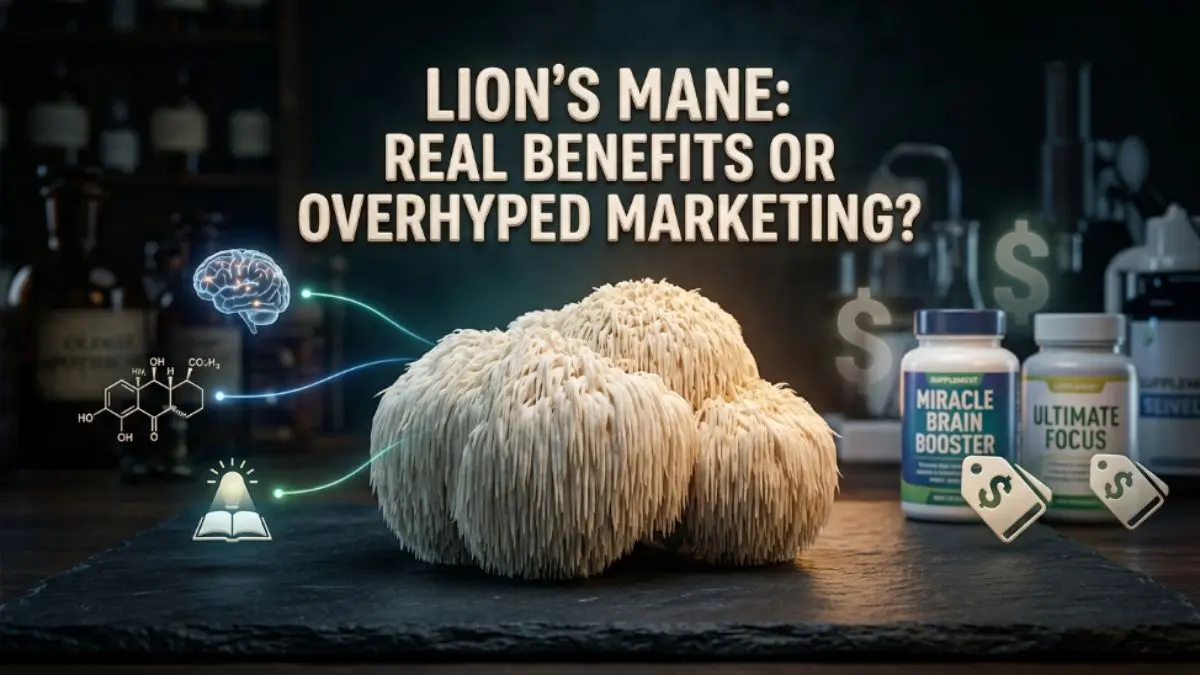
Lion’s Mane: Real Benefits or Overhyped Marketing?
If you’ve been weighing the lion’s mane mushroom benefits against the marketing, you’ve probably noticed the two don’t quite line up. One side promises a shaggy white mushroom that regrows your brain and erases fog overnight. The other side, the actual research, tells a slower and more interesting story — one with real mechanisms, a handful of human trials, and some genuine limits worth knowing before you spend a cent.
This mushroom has become the poster child of the nootropic boom, plastered across coffee blends, gummies, and capsules. That popularity is exactly why it’s worth separating what’s demonstrated from what’s sold.
Disclaimer: This content is for informational purposes only and is not a substitute for professional medical advice. Always consult a qualified healthcare provider before acting on any recommendation here.
What follows is a straight read of where lion’s mane stands: how it’s supposed to work, what human studies have and haven’t shown, where the marketing overreaches, and how to judge whether a product is worth your money.
The Hype Versus the Mushroom: What Lion’s Mane Actually Is
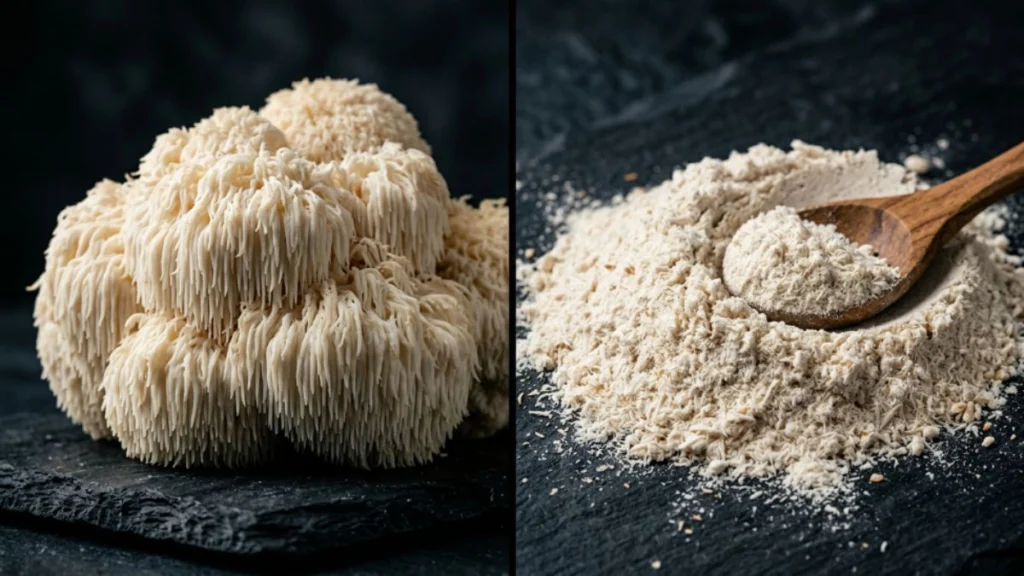
Lion’s mane (Hericium erinaceus) is an edible mushroom that’s been used in East Asian kitchens and traditional medicine for centuries. It grows in white, cascading spines that look a little like a frozen waterfall. Two parts of it matter for supplements: the fruiting body (the visible mushroom) and the mycelium (the root-like network grown on a substrate). They contain different active compounds, and that distinction turns out to be central to whether a product does anything at all.
The interest isn’t folklore alone. Lion’s mane contains two unusual families of molecules — hericenones, concentrated in the fruiting body, and erinacines, found in the mycelium. Both have drawn attention because, in laboratory and animal models, they appear to influence the nervous system in ways most foods simply don’t.
How Lion’s Mane Is Supposed to Work
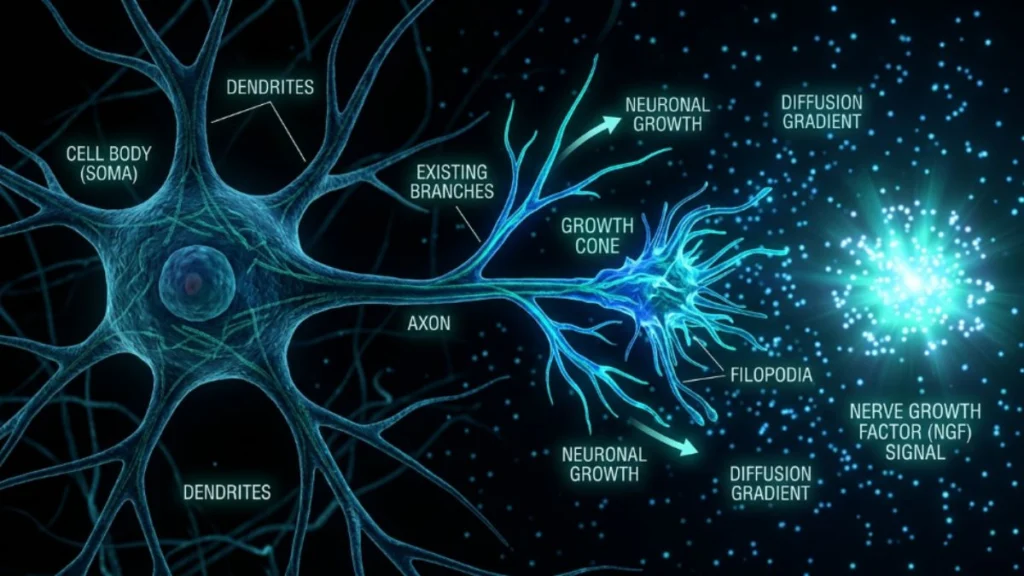
The mechanism people get excited about is nerve growth factor, or NGF — a protein that helps neurons grow, repair, and stay alive. Lion’s mane compounds have stimulated NGF activity in cell and animal studies, and some human work points to effects on BDNF, a related protein tied to learning and mood. In principle, supporting these signals could help the brain maintain and rebuild connections, which is why the mushroom gets framed as a tool for long-term brain health rather than a same-day stimulant.
That framing matters. Lion’s mane is not caffeine. You don’t take it and feel a jolt twenty minutes later. If it works, it works the way a slow structural investment works — quietly, over weeks. There’s also early interest in a second pathway: some researchers suspect part of the effect may run through the gut, where lion’s mane appears to influence the microbiome and, indirectly, the signals that reach the brain. It’s an emerging idea rather than settled science, but it fits the broader picture of an ingredient that nudges biology gently rather than forcing it. Understanding what actually changes in the brain as we age helps explain why a neurotrophic mechanism is appealing in the first place, and why its payoff would be gradual rather than instant.
What the Lion’s Mane Mushroom Benefits Evidence Actually Show
Here’s the part the marketing skips: the human evidence is real, but it’s thin, and it’s mixed. A small number of decent trials exist. They’re encouraging. They are not the avalanche of proof the ads imply.
The Older-Adult Memory Trial
The most-cited human study followed Japanese adults aged 50 to 80 with mild cognitive impairment. Over sixteen weeks, the group taking lion’s mane showed steady improvement on a cognitive scale compared with placebo. The detail that rarely makes it into a product page is what happened next: when supplementation stopped, the benefit faded within about four weeks. The takeaway isn’t “it doesn’t work” — it’s that any benefit appears to depend on consistent, ongoing use, not a short trial run.
The Young-Adult Studies
More recent work tested healthy young adults. In one double-blind pilot, a single dose was linked to faster performance on a test of mental processing speed, with a trend toward lower stress after 28 days. Promising — but the same study reported null and even slightly negative results on other measures, and the sample was small. The authors themselves urged caution in interpreting it. That honesty is exactly what’s missing from most marketing.
Where the Evidence Falls Short
Step back and the pattern is clear. Preclinical research — cells and animals — is genuinely strong and consistent. Human research is early: a few small trials, short durations, varied doses and extract types, and outcomes that don’t always agree. An independent review by the Alzheimer’s Drug Discovery Foundation rates the human evidence as preliminary, not established. So the accurate verdict on lion’s mane is “promising, plausible, under-proven” — three words you’ll never see on a label.
What the Marketing Gets Wrong

Once you know the science, the overreach becomes easy to spot. A few claims deserve a skeptical eye.
- “Regrows your brain instantly.” No human study shows acute memory transformation. The one older-adult trial took weeks and reversed after stopping. Anything promising overnight results is selling sensation, not data.
- Fruiting body versus mycelium confusion. Many cheap products use mycelium grown on grain, which can leave the final powder mostly starch with little active compound. The label may say “lion’s mane” while delivering very little of what was studied.
- No standardization. The compounds that matter — hericenones and beta-glucans — are rarely quantified on labels. “500 mg of mushroom” tells you nothing about potency if the extract isn’t standardized.
- Single-ingredient miracle framing. In the trials that worked, lion’s mane was the whole intervention in a controlled setting. In real life, cognition responds to several inputs at once, which is why isolated single ingredients often underwhelm.
How to Actually Get Value From Lion’s Mane
Affiliate Disclosure: This article contains affiliate links. If you click through and make a purchase, Cognitive Insight Lab may earn a small commission — at no extra cost to you. We only recommend options we’ve genuinely researched and believe may offer real value. Our editorial opinions are always our own.
If you decide to try it, a few principles separate a fair test from wasted money. Treat these as your checklist:
- Use a real extract, not raw powder. Look for a concentrated fruiting-body extract, ideally standardized for beta-glucans, rather than mycelium-on-grain filler.
- Give it weeks, not days. The human evidence points to eight to sixteen weeks of consistent use. Judging it after a few days is judging the wrong thing.
- Check the label the way you’d check any supplement. If you’re unsure what to scrutinize, it’s worth learning how to read a supplement label so vague “blends” can’t hide the real dose.
- Think in stacks, not heroes. Because cognition responds to multiple inputs, lion’s mane tends to perform better as one part of a complete formula than as a lone capsule.
That last point is where most people quietly course-correct. After trying isolated mushroom powders with little to show for it, many move toward a single, transparent formula that includes a properly extracted lion’s mane alongside other researched ingredients — partly for potency, and partly because one well-built capsule is far easier to stay consistent with than a shelf of single jars.
Who Lion’s Mane Is — and Isn’t — For
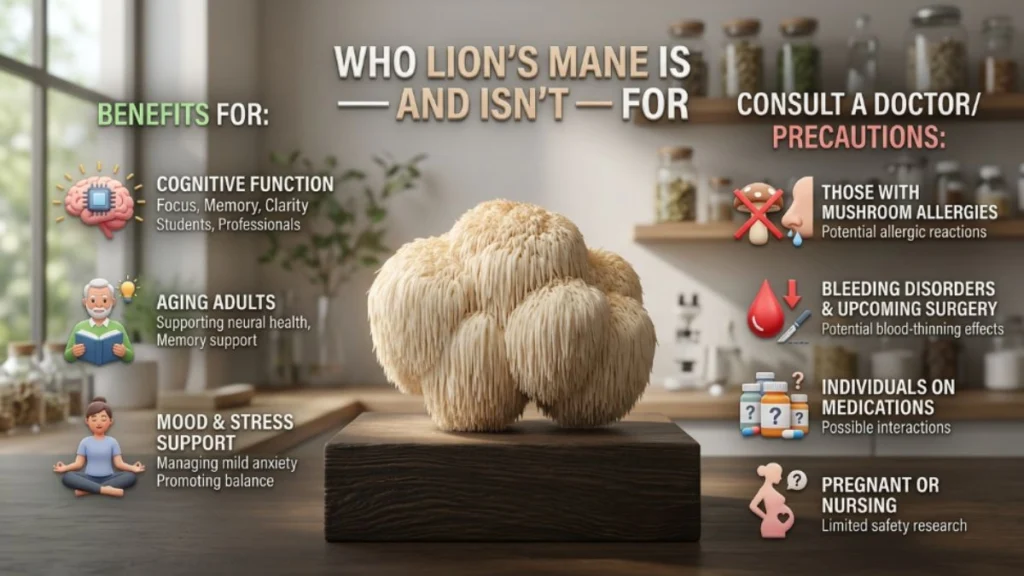
Matching an ingredient to the right person is half of using it well. Lion’s mane fits some goals far better than others.
It makes the most sense for someone playing a long game: an adult in their forties or beyond who’s noticing gradual slippage in recall and is willing to commit to consistent use for a couple of months. Because its proposed mechanism is structural — supporting the proteins that keep neurons healthy — it rewards patience rather than impatience. It also pairs naturally with the basics that actually move cognition, like sleep and physical activity, instead of fighting them.
It’s a poor fit for anyone expecting a stimulant. If your problem is acute, situational focus — a deadline this afternoon, an exam tomorrow — lion’s mane is the wrong tool, and you’ll likely conclude it “did nothing” simply because you measured it against the wrong yardstick. It’s also a weak choice for people who won’t stick with it. The one trial that showed clear benefit also showed that stopping erased the gain, so an on-and-off routine is close to no routine at all.
There’s a subtler point here about expectations. Cognitive change after a certain age is rarely caused by one deficiency, so it’s rarely fixed by one compound. Treating lion’s mane as a single magic input ignores how the brain actually responds — to sleep, movement, blood sugar, stress, and several nutrients working together. Seen that way, the mushroom is a contributor, not a cure, and the people who get value from it tend to be the ones who already have the fundamentals in place.
If you’re weighing lion’s mane against other options, it’s worth seeing how it stacks up head-to-head in our citicoline vs lion’s mane comparison for focus and memory.
The Honest Verdict: Real, but Not a Miracle
Lion’s mane is not snake oil and it’s not a brain transplant. It sits in the honest middle: a mushroom with a credible neurotrophic mechanism, a few encouraging human trials, and a marketing industry running several lengths ahead of the data. Used realistically — a quality extract, taken consistently, as part of a broader approach — it’s a reasonable ingredient to include. Used the way the ads pitch it, it will disappoint.
If you’d rather not gamble on a random single-ingredient tub, the more reliable path is a complete, fully-disclosed formula where lion’s mane is dosed properly alongside complementary nootropics, then giving it the eight to twelve weeks the research suggests it needs. And if focus rather than long-term memory is your real goal, it’s worth first mapping out how to choose a stack that matches your actual bottleneck before buying anything at all.
Medical Disclaimer: The information in this article is provided for educational purposes only and is not intended as medical advice, diagnosis, or treatment. Results vary from person to person. If you have a medical condition, are taking medication, or have any health concerns, consult a licensed healthcare professional before trying any supplement.
Frequently Asked Questions
Does lion’s mane actually improve memory?
The human evidence is genuinely promising but limited. The strongest trial showed improved cognitive scores in older adults with mild impairment over sixteen weeks — though the benefit faded after they stopped. It’s reasonable support, not a guaranteed memory boost.
How long does lion’s mane take to work?
Plan for weeks, not days. The studies that found benefits ran eight to sixteen weeks of daily use. Lion’s mane works gradually through a neurotrophic mechanism, not as a same-day stimulant.
Is lion’s mane overhyped?
Partly. The mechanism and early research are real, but marketing routinely overstates the proof and promises instant results no study supports. The accurate description is “promising and under-proven.”
What’s the difference between fruiting body and mycelium?
The fruiting body is the visible mushroom; the mycelium is the root network, often grown on grain. Cheap products use grain-grown mycelium that can be mostly starch with little active compound. A concentrated fruiting-body extract is generally the better choice.
Is lion’s mane safe to take daily?
For most healthy adults it has a good safety profile and is well tolerated. As with any supplement, “natural” doesn’t mean risk-free for everyone — check with your doctor first, especially if you take medication or have an existing condition.
Should I take lion’s mane alone or in a formula?
In real-world use, isolated single ingredients often underwhelm because cognition depends on several inputs. A properly dosed lion’s mane inside a complete formula is usually easier to sustain and more likely to deliver noticeable value.
What should I look for when buying lion’s mane?
A standardized fruiting-body extract (ideally listing beta-glucan content), transparent per-ingredient dosing rather than a hidden blend, and third-party testing for purity. Skip anything promising overnight results.

Daniel Mercer é um escritor de ciências da saúde especializado em desempenho cognitivo, nootrópicos e pesquisas sobre saúde cerebral. Com formação em ciências biomédicas e mais de uma década de experiência revisando literatura clínica sobre desempenho mental e suplementação, ele fundou o Cognitive Insight Lab para simplificar informações irrelevantes e fornecer análises baseadas em evidências para pessoas que levam a sério sua saúde cognitiva. Daniel não aceita conteúdo patrocinado e não possui vínculos financeiros com as marcas analisadas neste site.