
Citicoline vs Lion’s Mane: Which Is Better for Focus and Memory?
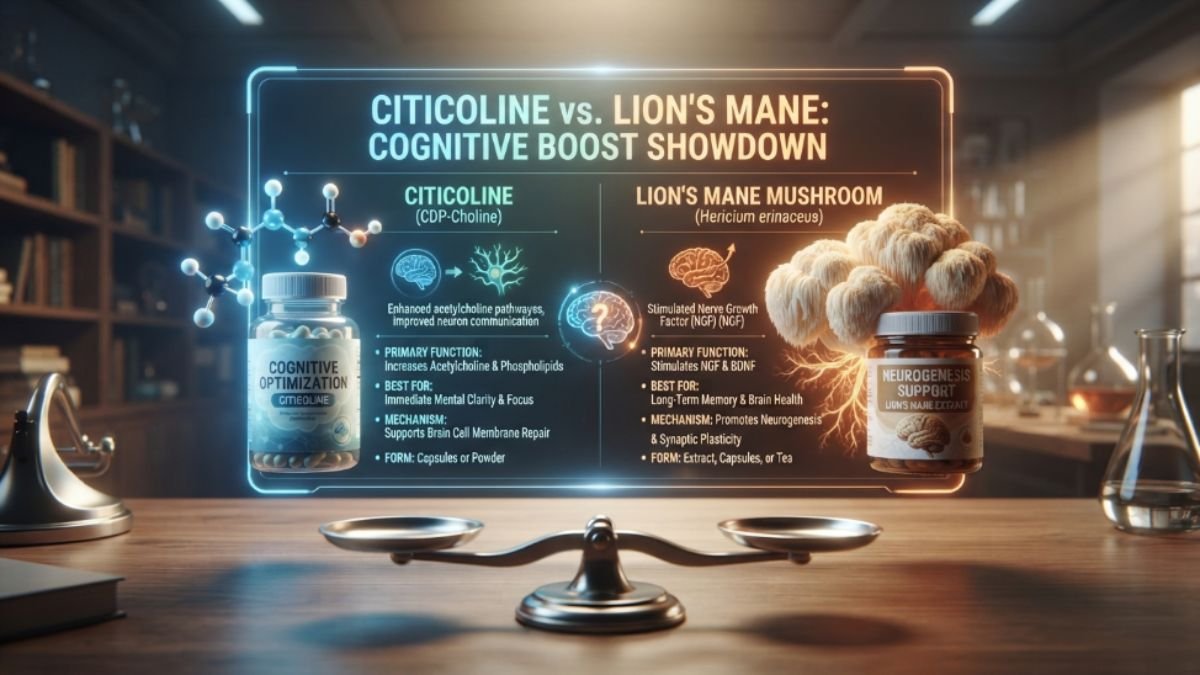
The citicoline vs lion’s mane debate dominates almost every serious conversation about sharper thinking, and the two could not be more different under the hood. One is a fast-acting brain-energy compound your neurons already know how to use.
The other is a mushroom that works slowly and quietly, rebuilding the machinery of your nervous system over weeks. Most people searching for the winner assume it comes down to which one is simply stronger. It almost never does. It comes down to what you want your brain to do, and how soon you need it.
After years spent reading through cognitive-supplement research and answering questions from readers stuck in the same afternoon fog, I can tell you the citicoline-versus-lion’s-mane debate is one of the most common ones I see.
The honest answer has a few moving parts. By the end of this, you’ll know which compound fits your situation, how the evidence really stacks up on each side, and exactly where the marketing tends to sprint ahead of the science.
Disclaimer: This content is for informational purposes only and does not replace professional medical advice. Always consult a qualified healthcare professional before following any recommendations.
What Citicoline Actually Does in Your Brain
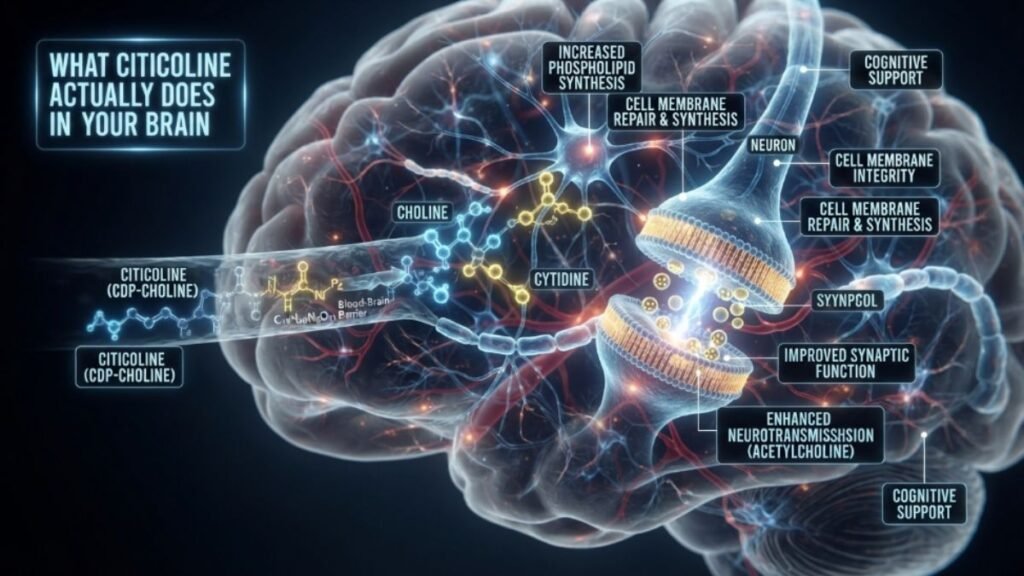
Citicoline, sometimes written as CDP-choline, is a compound your body already manufactures on its own. It earns its reputation by handling two jobs that matter enormously for daily mental performance.
First, it supplies raw material for acetylcholine, the neurotransmitter most closely tied to attention, learning, and recall. When acetylcholine signaling runs smoothly, focus feels effortless; when it lags, tasks that should take minutes start to drag.
Second, citicoline feeds the production of phosphatidylcholine, a structural fat that forms part of the membrane wrapping every one of your neurons. Healthy membranes mean faster, cleaner electrical signaling between brain cells.
The practical upshot is that citicoline behaves less like a long-term reconstruction project and more like restoring power to a building. People often describe a subtle lift in mental clarity and drive rather than a jittery jolt. There is no caffeine in it and no crash attached to it, which is part of why it has become a staple in so many focus formulas.
The Evidence Behind Citicoline
This is where citicoline separates itself from a lot of trendy compounds: it has been tested in real people, not just in petri dishes. In one randomized, double-blind, placebo-controlled trial, 100 healthy adults between 50 and 85 with age-related memory complaints took 500 mg of citicoline daily for twelve weeks and showed measurable improvements in memory compared with placebo. You can read the full clinical trial on citicoline and memory for the specifics.
Other work has looked at attention and processing speed in younger adults, with citicoline consistently landing on the side of “modest but real” benefits for sustained attention. The pattern across studies is encouraging without being miraculous: citicoline tends to help most where there is a deficit to correct, and it tends to work on a timescale of days to a few weeks rather than months.
What Lion’s Mane Actually Does in Your Brain

Lion’s mane (its botanical name is Hericium erinaceus) plays an entirely different game. Instead of topping up neurotransmitters or energizing membranes, it works on the brain’s capacity to grow and repair itself, something we cover in more depth in our full breakdown of lion’s mane’s benefits for the brain.
Its two headline compounds, hericenones and erinacines, are studied for their ability to stimulate nerve growth factor, or NGF. NGF is a protein your brain uses to create, maintain, and repair neurons and the myelin sheaths that insulate them.
Think of citicoline as sharpening the tools you already own, and lion’s mane as slowly hiring more workers and repairing the workshop. That distinction is the single most useful thing to understand before you spend a cent on either.
Because of this mechanism, lion’s mane is a patience compound. It does not usually deliver a same-day “I can feel it” experience. Its promise is cumulative: steadier mood, better resilience, and support for long-term cognitive health when taken consistently over weeks and months.
The Evidence Behind Lion’s Mane
The most-cited human study followed older adults with mild cognitive impairment who improved while taking lion’s mane and slipped back after they stopped, which hints that the benefit depends on continued use. In healthy younger adults the picture is genuinely mixed: some trials found faster performance on specific tasks after a single dose, while others found no meaningful change in overall cognition or mood.
For a balanced, non-promotional read on where the science currently sits, the Alzheimer’s Drug Discovery Foundation’s review of lion’s mane is one of the fairer summaries available, and it does not pretend the evidence is stronger than it is. That honesty matters, because a great deal of lion’s mane marketing leans on animal studies and hopeful extrapolation rather than robust human trials.
Citicoline vs Lion’s Mane: A Head-to-Head Comparison

Here is the practical side-by-side, stripped of the hype, so you can see the trade-offs at a glance.
| Factor | Citicoline | Lion’s Mane |
|---|---|---|
| Primary action | Acetylcholine support and brain-cell energy | Nerve growth factor and neuroplasticity |
| How fast you notice it | Days to a few weeks | Weeks to months |
| Best suited for | Focus, attention, and near-term memory | Long-term brain resilience and repair |
| Strongest human evidence | Memory in older adults | Mild cognitive impairment; mixed in healthy adults |
| Typical daily dose | 250 to 500 mg | 500 mg to 3 g |
| Feel | Subtle, clean alertness | No stimulant sensation |
| What to look for on the label | A standardized, studied form | Fruiting-body extract with stated strength |
The table makes the real lesson obvious. These are not competitors chasing the same job. They are two different tools, and the “better” one is whichever matches the problem in front of you.
Which One Should You Choose?
Instead of asking which supplement wins, ask what you actually need this month.
If You Want Noticeable Focus Sooner
If your main complaint is fading attention, a cloudy head by mid-afternoon, or memory that feels one step behind, citicoline is the more logical starting point. Its effects arrive on a human timescale you can actually perceive, and its mechanism maps directly onto the symptoms most people describe as brain fog. It is the choice for someone who wants to feel a difference in their working week, not their working decade.
If You’re Playing the Long Game for Brain Health
If you are less worried about tomorrow’s meeting and more focused on protecting your mind over the coming years, lion’s mane is the more sensible bet. Its NGF-related activity is aimed at maintenance and repair, which is exactly the kind of slow, compounding benefit that rarely announces itself day to day but may matter a great deal over time. It rewards consistency and patience.
Why You Might Not Have to Choose
Here is the part the “versus” framing hides: because citicoline and lion’s mane act through completely different pathways, they don’t compete inside your brain. They complement each other. Citicoline handles today’s signaling and energy; lion’s mane invests in tomorrow’s structure. Stacking both is one of the most common strategies among people who take cognitive support seriously.
The catch is logistics. Buying two separate products, matching the doses to what the research actually used, and remembering to take them consistently is more friction than most people sustain. That is why so many readers who don’t want to build and manage a stack from scratch instead reach for a single formula that already pairs both compounds at researched doses, which removes the guesswork of assembling one yourself.

How to Take Citicoline and Lion’s Mane
Getting the details right matters more than most people expect, because a good compound at the wrong dose or timing quietly underperforms.
- Citicoline: Studied doses generally sit between 250 and 500 mg per day. Morning is a natural fit, since its mild alertness suits the front half of the day. It can be taken with or without food.
- Lion’s mane: Effective amounts in the research range widely, from around 500 mg of concentrated extract up to 3 g of a whole-mushroom preparation. Consistency beats intensity here; a daily habit over several weeks is what gives it a chance to work.
- Label literacy: For citicoline, look for a standardized, clinically studied form rather than a vague “choline complex.” For lion’s mane, favor a product that specifies fruiting-body extract and states its strength, because mycelium-on-grain fillers can dilute the active compounds.
If you want a framework for evaluating any brain supplement before you buy, the criteria you use matter as much as the ingredient itself, and it helps to know how to choose a cognitive supplement that earns its place before you commit to either one.
What the Research Still Can’t Tell Us
Honesty is the whole point of a comparison like this, so here is the uncomfortable half.
Many of the human trials on both compounds are small, short, or run in specific populations, which makes it risky to promise the same results for a healthy 30-year-old that a study found in a 70-year-old. Lion’s mane in particular suffers from inconsistent products, and the fruiting-body-versus-mycelium debate means two bottles labeled the same way can contain very different amounts of active compounds.
Regulators have been cautious too. When European authorities formally evaluated citicoline’s memory claims, they concluded the evidence did not yet establish a definitive cause-and-effect relationship, a position laid out in their official scientific evaluation of citicoline and memory. None of this means the compounds don’t work. It means you should treat bold, guaranteed-results marketing with healthy skepticism and set realistic expectations.
Medical disclaimer: The information provided in this article is for educational purposes only and is not intended to serve as medical advice, diagnosis, or treatment. Results may vary from person to person. If you have a medical condition, take medication, or have any health concerns, consult a licensed healthcare professional before trying any supplement.
The Bottom Line
Citicoline and lion’s mane are not rivals fighting for the same crown. Citicoline is your answer when you want sharper focus and memory on a timeline you can feel, and it carries the more direct human evidence for near-term cognitive support. Lion’s mane is your answer when you are investing in long-range brain health and are willing to be patient while it works underneath the surface.
Choose citicoline for the present, lion’s mane for the future, and consider both when you want to cover each pathway at once. If building and maintaining that routine yourself feels like more effort than it’s worth, a ready-made formula designed around this exact pairing is the simplest way to put everything here into practice without turning your kitchen counter into a pharmacy.
Frequently Asked Questions
Can you take citicoline and lion’s mane together?
Yes. They work through separate, complementary mechanisms, so taking them together is common and logical. Start each at a standard dose and, as with any new supplement combination, check with a healthcare professional if you take medication.
Which one works faster, citicoline or lion’s mane?
Citicoline. Its effects on focus and mental energy tend to show up within days to a couple of weeks, while lion’s mane usually needs several weeks of consistent use before any benefit becomes noticeable.
Does lion’s mane really regrow brain cells?
Not exactly. Lion’s mane is studied for stimulating nerve growth factor, a protein involved in maintaining and repairing neurons. That is a supportive role in neuroplasticity, not a guarantee of “regrowing” the brain, and the strongest evidence so far comes from specific populations rather than the general public.
Is citicoline a stimulant?
No. It provides a subtle, clean sense of alertness by supporting acetylcholine and brain-cell energy, without caffeine and without the crash that stimulants can cause.
How long before lion’s mane starts working?
Most research protocols run for four weeks or longer, and real-world users often report needing a similar stretch of daily use before noticing anything. It is a compound built on consistency, not quick wins.
Are there side effects to worry about?
Both are generally well tolerated in studies. Some people experience mild digestive upset, and individual responses vary. Anyone who is pregnant, breastfeeding, managing a health condition, or taking medication should speak with a healthcare provider first.
Which is better specifically for brain fog?
It depends on the cause. If your fog is about slow, foggy focus and mental fatigue, citicoline maps more directly onto that experience. If it is tangled up with long-term stress and cognitive wear, lion’s mane may be the better foundation, and pairing the two covers both angles.

Daniel Mercer é um escritor de ciências da saúde especializado em desempenho cognitivo, nootrópicos e pesquisas sobre saúde cerebral. Com formação em ciências biomédicas e mais de uma década de experiência revisando literatura clínica sobre desempenho mental e suplementação, ele fundou o Cognitive Insight Lab para simplificar informações irrelevantes e fornecer análises baseadas em evidências para pessoas que levam a sério sua saúde cognitiva. Daniel não aceita conteúdo patrocinado e não possui vínculos financeiros com as marcas analisadas neste site.