
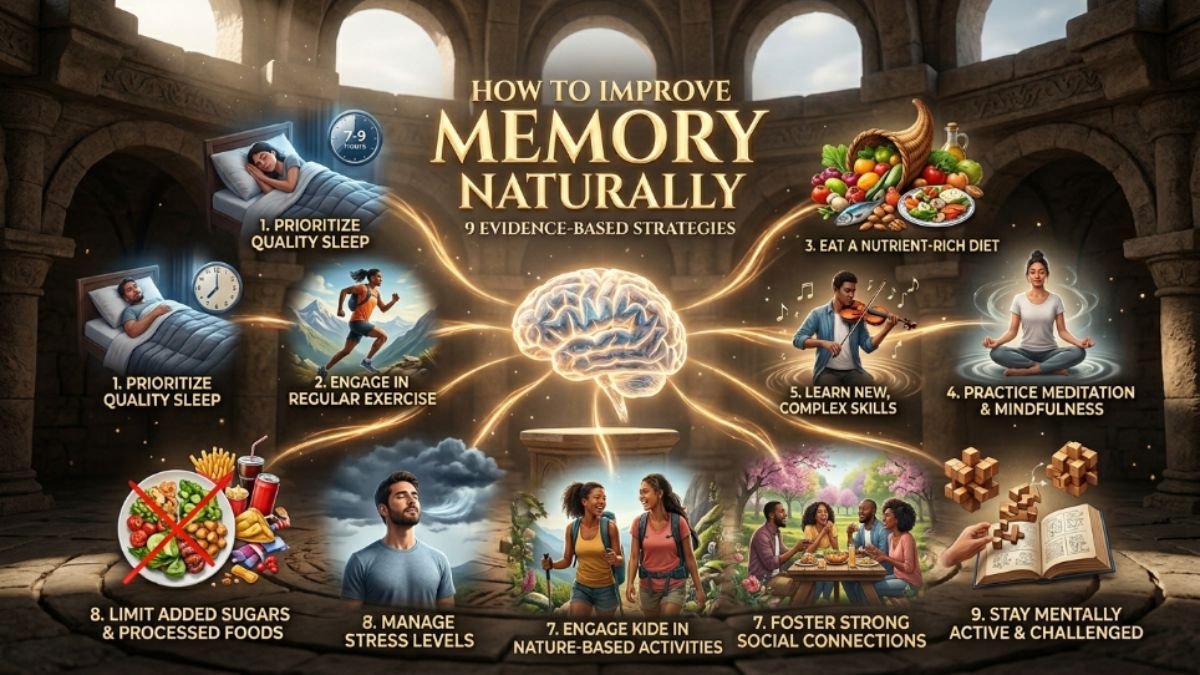
How to Improve Memory Naturally: 9 Evidence-Based Strategies
Learning how to improve memory naturally is one of the most searched cognitive health topics among American adults — and the urgency behind those searches is real. If you’ve walked into a room and immediately forgotten why you’re there, or reached for a name that simply won’t surface, you’re not imagining a problem. You’re noticing something that researchers have been tracking carefully: a measurable decline in memory encoding and retrieval that often begins in the early 40s, accelerates with lifestyle factors, and is far more reversible than most people assume.
According to the Alzheimer’s Association, more than 6 million Americans currently live with Alzheimer’s disease — and the majority of cases involve a long preclinical phase during which lifestyle interventions can meaningfully alter trajectory. For the broader population, a 2020 study published in JAMA Neurology found that modifiable risk factors account for approximately 40% of dementia cases globally. That 40% is where natural strategies live.
Disclaimer: This content is for informational purposes only and does not replace professional medical advice. Always consult a qualified healthcare professional before following any recommendations.
What makes memory feel like it’s slipping — when it does — is rarely one thing. It’s a convergence: fragmented sleep, chronic low-grade stress, nutritional gaps, and the kind of cognitive passivity that comes with repetitive, low-demand daily routines. The good news is that the same convergence principle works in reverse. Stacking the right interventions, consistently, produces measurable results.
In this article, you’ll find nine strategies with genuine research backing — not generic wellness advice, but approaches with documented neurobiological mechanisms. Each one is actionable starting today, without prescriptions, lab tests, or expensive equipment.
⚠️ Important Notice: This content is for informational and educational purposes only. It does not constitute medical advice and does not replace the guidance of a qualified healthcare professional. Please consult your doctor before making changes to your diet, supplementation routine, or cognitive health protocol — especially if you have an existing medical condition or take prescription medications.
Why Memory Declines — and Why That’s Not Inevitable
Before addressing how to improve memory naturally, it’s worth understanding what’s actually happening when memory starts to feel unreliable. This isn’t just background — it’s the framework that explains why each strategy on this list works.
The Hippocampus: Your Memory’s Control Center
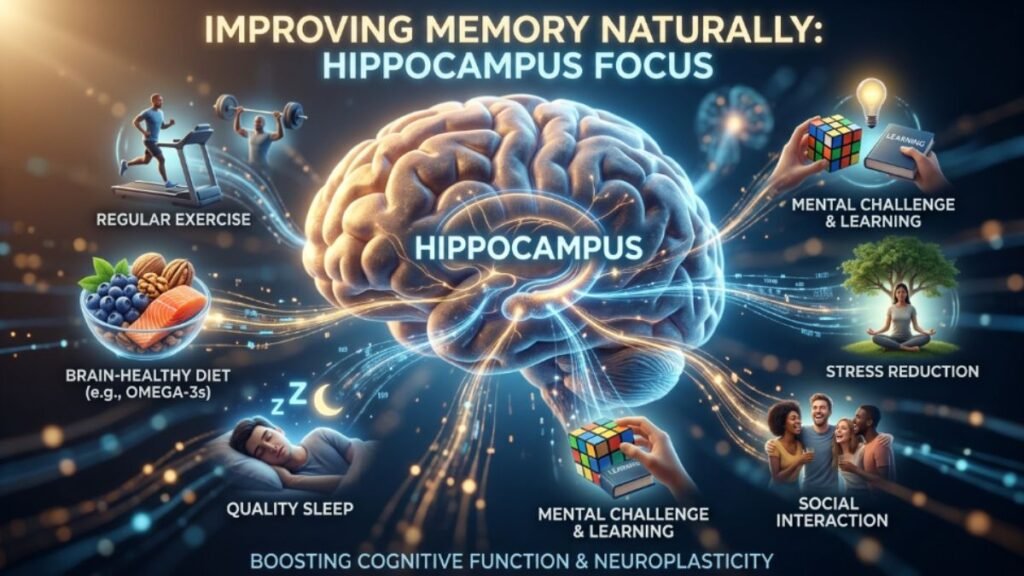
The hippocampus is the brain region most critical to forming new memories and consolidating them into long-term storage. It is also one of the first regions affected by age-related change, stress-induced cortisol exposure, and sleep deprivation. Hippocampal volume naturally decreases with age at a rate of approximately 0.5–1% per year in adults who don’t take countermeasures — but research consistently shows this rate is not fixed.
A landmark study from the University of Illinois found that adults who engaged in regular aerobic exercise over 12 months showed a 2% increase in hippocampal volume — effectively reversing approximately two years of age-related decline. The mechanism involves increased production of Brain-Derived Neurotrophic Factor (BDNF), a protein that promotes neuronal survival, synaptic plasticity, and the formation of new memory-encoding circuits.
The Encoding-Consolidation-Retrieval Loop
Memory is not a single process — it’s a loop with three distinct phases:
- Encoding: The initial registration of information. Attention is the prerequisite. Without full attentional focus, encoding is shallow and retrieval becomes unreliable.
- Consolidation: The stabilization of a memory trace, which occurs primarily during deep sleep. Without adequate slow-wave sleep, newly encoded information degrades before it becomes durable.
- Retrieval: Accessing stored information. Retrieval is strengthened by practice (active recall) and weakened by stress hormones, inflammation, and metabolic dysfunction.
Understanding this loop clarifies why fragmented sleep, chronic distraction, and chronic stress are so damaging to memory — each one disrupts a different phase of the same system.
Strategy 1: Prioritize Sleep Architecture, Not Just Sleep Duration
Of all the interventions on this list, sleep has the most direct and well-documented relationship with memory consolidation. And the key variable is not simply how many hours you sleep — it’s the quality and structure of those hours.
Slow-Wave Sleep and Memory Consolidation
During slow-wave sleep (SWS), also called deep sleep or N3 sleep, the brain undergoes a process called memory replay: neural patterns activated during waking experiences are reactivated and consolidated from short-term hippocampal storage into more stable cortical networks. This is not metaphorical — researchers have used EEG to directly observe this process, and disrupting SWS measurably impairs next-day declarative memory performance.
A 2019 study from the NIH’s National Institute of Neurological Disorders and Stroke found that the glymphatic system — the brain’s waste-clearance mechanism — operates almost exclusively during sleep, primarily SWS. This system clears metabolic waste including amyloid-beta, the protein associated with Alzheimer’s pathology. Poor sleep hygiene doesn’t just impair memory acutely — it may accelerate the accumulation of neuropathological debris over years.
Practical Sleep Optimization for Memory
- Maintain a consistent sleep schedule — including weekends. Circadian rhythm consistency is more protective than total sleep time flexibility.
- Keep the bedroom cool (65–68°F / 18–20°C) — core body temperature drop is a physiological trigger for slow-wave sleep entry.
- Eliminate blue light exposure 90 minutes before bed — blue light suppresses melatonin, delaying sleep onset and reducing early-cycle deep sleep.
- Avoid alcohol within 3 hours of sleep — alcohol may accelerate sleep onset but fragments the second half of the sleep cycle, reducing REM and SWS proportions significantly.
⚠️ Attention: If you consistently wake unrefreshed despite 7–8 hours of sleep, consider evaluation for obstructive sleep apnea, which is significantly underdiagnosed in adults over 40 and directly impairs memory consolidation through repeated micro-arousals during the night.
Strategy 2: Use Aerobic Exercise as a Neurological Tool
The evidence connecting aerobic exercise to memory improvement is among the most robust in cognitive neuroscience — and it operates through mechanisms that go well beyond general health benefits.
How Exercise Rebuilds Memory Infrastructure
Aerobic exercise triggers the release of BDNF, which the brain science community sometimes refers to as a “neurotrophic growth signal.” BDNF promotes neurogenesis — the formation of new neurons — specifically in the dentate gyrus of the hippocampus, a subregion closely linked to pattern separation, a cognitive function critical for distinguishing between similar memories.
Beyond BDNF, exercise also increases cerebral blood flow, delivering more glucose and oxygen to memory-relevant brain regions, and reduces systemic inflammation — a major contributor to cognitive decline that is often overlooked in lifestyle discussions.
The dose-response relationship matters here. Research from the Cooper Institute suggests that 150 minutes of moderate-intensity aerobic activity per week (the current CDC recommendation) is sufficient to produce measurable cognitive benefits. Higher volumes show additional gains, but the threshold effect kicks in well below elite fitness levels.
💡 Practical Tip: Morning aerobic exercise — even a 20-minute brisk walk — appears to enhance the encoding phase of memory for the hours that follow, likely through catecholamine release (dopamine, norepinephrine) that sharpens attentional capacity. If you’re preparing for a demanding cognitive day, move before you sit down to work.

Strategy 3: Redesign Your Diet Around Brain-Protective Nutrients
What you eat directly shapes the biochemical environment in which your neurons operate. Three dietary frameworks have the strongest evidence base for memory preservation and enhancement.
The Mediterranean and MIND Diet Patterns
The MIND diet (Mediterranean-DASH Intervention for Neurodegenerative Delay), developed by researchers at Rush University, was specifically designed to target Alzheimer’s risk. A landmark observational study found that high adherence to the MIND diet was associated with cognitive function equivalent to a brain approximately 7.5 years younger than low-adherence individuals.
The diet emphasizes:
- Leafy greens (6+ servings/week) — high in folate, vitamin K, and lutein, all associated with slower cognitive decline
- Berries (2+ servings/week) — anthocyanins reduce oxidative stress in hippocampal tissue
- Fatty fish (1+ serving/week) — DHA, an omega-3 fatty acid, is a structural component of neuronal membranes
- Olive oil as the primary fat — oleocanthal has anti-inflammatory properties comparable to low-dose ibuprofen
- Nuts (5+ servings/week) — vitamin E, magnesium, and healthy fats support synaptic function
Key Nutrients for Memory Function
| Nutrient | Primary Source | Memory-Relevant Mechanism |
|---|---|---|
| DHA (Omega-3) | Fatty fish, algae oil | Neuronal membrane fluidity; BDNF upregulation |
| Magnesium | Dark leafy greens, nuts | Synaptic plasticity; NMDA receptor function |
| Vitamin D3 | Sunlight, fatty fish, supplements | BDNF expression; hippocampal neuroprotection |
| B12 | Animal products, fortified foods | Myelin maintenance; homocysteine regulation |
| Choline | Eggs, liver, lecithin | Acetylcholine synthesis — the memory neurotransmitter |
| Lutein | Kale, spinach, egg yolks | Reduces cortical oxidative stress; linked to better recall |
✓ Best Practice: Vitamin D deficiency affects an estimated 42% of American adults and is strongly associated with accelerated cognitive decline. A simple blood test (25-hydroxyvitamin D) can identify your status. Target levels of 40–60 ng/mL are associated with optimal cognitive protection in research literature.
Strategy 4: Train Your Brain with Active Recall and Spaced Repetition
Not all learning strategies are equally effective for long-term memory retention. The method you use to encode information is as important as the information itself — and most adults default to the least effective method available: passive re-reading.
Why Passive Review Fails Memory
Re-reading a text, scrolling through notes, or reviewing slides creates an illusion of knowing — it increases familiarity without strengthening the retrieval pathway. When you actually need to recall the information, the pathway was never built.
Active recall — forcing your brain to retrieve information without looking at it — is neurologically distinct. The act of retrieval itself strengthens the memory trace. This is documented in what researchers call the “testing effect,” with studies showing that active recall practice produces 50–80% better long-term retention compared to passive review.
Spaced repetition amplifies this further by scheduling recall attempts at increasing intervals — reviewing a piece of information at 1 day, then 3 days, then 7 days, then 21 days. Each successful retrieval at the edge of forgetting produces a more durable memory encoding.
Practical Application for Adults
- Replace re-reading with flashcards or self-quizzing — after reading something you want to remember, close the source and write down everything you recall. Then check.
- Use the Feynman Technique — explain what you’ve learned in simple language as if teaching someone who knows nothing about the topic. Gaps in your explanation reveal gaps in your encoding.
- Apply spaced repetition apps — tools like Anki use algorithms to schedule reviews at scientifically optimal intervals for memory consolidation.
👉 NATURAL NOOTROPICS THAT SUPPORT MEMORY ENCODING:
What Are Nootropics? A Clear, Evidence-Based Guide
Strategy 5: Manage Cortisol — Chronic Stress Is Memory’s Biggest Threat
Stress is the most consistently underestimated enemy of memory function — and the mechanism is direct, not metaphorical.
How Cortisol Damages Memory Infrastructure
The adrenal glands release cortisol in response to stress. In acute, short-term situations, cortisol actually enhances memory consolidation — this is why emotionally intense events are remembered more vividly than neutral ones. The problem is chronic cortisol elevation.
Sustained high cortisol levels:
- Suppress hippocampal neurogenesis — directly reducing the brain’s capacity to form new memories
- Damage dendritic spines — the tiny projections on neurons that form synaptic connections; under chronic cortisol exposure, these physically retract
- Impair prefrontal cortex function — the region governing working memory and cognitive control
A 2018 study from Boston University found that middle-aged adults with higher cortisol levels scored lower on memory and cognitive tests — and showed measurable differences in brain structure compared to lower-cortisol peers.
Evidence-Based Stress Management for Memory
- Mindfulness-based stress reduction (MBSR): An 8-week MBSR program has been shown in multiple RCTs to reduce cortisol, increase gray matter density in the hippocampus, and improve memory performance.
- Diaphragmatic breathing: Activates the parasympathetic nervous system within minutes, reducing cortisol output and restoring prefrontal function.
- Social connection: Loneliness is now recognized as a cortisol-elevating chronic stressor. Consistent, meaningful social engagement is independently protective against cognitive decline.
⚠️ Attention: Persistent cognitive symptoms — significant memory gaps, confusion, personality changes, or language difficulties — are not normal consequences of stress and warrant medical evaluation. Not all memory problems are lifestyle-related.

Strategy 6: Leverage the Power of Quality Social Engagement
The role of social interaction in cognitive health is one of the most consistent findings in aging research — and one of the most frequently overlooked in lifestyle-focused discussions of memory.
The Neuroscience of Social Cognition
Social interaction is cognitively demanding in productive ways. It requires rapid information processing, emotional regulation, perspective-taking, working memory, and real-time language production — engaging distributed brain networks simultaneously. Regular social challenge maintains what researchers call cognitive reserve: the brain’s resilience against neurological disruption.
A 25-year longitudinal study from the Harvard Study of Adult Development, one of the longest-running studies on adult wellbeing, found that quality of relationships was the single strongest predictor of cognitive health in later life — outperforming diet, exercise, and even genetics in predictive power.
Practical Social Strategies with Cognitive Benefit
- Engage in group activities requiring real-time discussion — book clubs, debate groups, strategy games, volunteer work — over passive social media consumption
- Maintain diverse social networks — relationships with people significantly younger or older than you introduce novel perspectives that stimulate cognitive flexibility
- Teach or mentor — the act of explaining complex information to others is one of the highest-engagement cognitive exercises available
Strategy 7: Optimize Your Supplement Stack for Memory Support
For adults who have addressed the foundational lifestyle factors — sleep, exercise, diet, stress — targeted supplementation can provide additional support for memory-relevant neurochemistry. The key is understanding which compounds have genuine clinical backing versus which are riding marketing momentum.
Evidence-Informed Supplements for Memory
| Supplement | Evidence Level | Memory-Relevant Mechanism | Typical Dose Range |
|---|---|---|---|
| Lion’s mane mushroom | Moderate (human RCTs) | NGF stimulation; hippocampal support | 500–2,000 mg/day |
| Bacopa monnieri | Moderate (multiple RCTs) | Dendrite branching; acetylcholine activity | 300–450 mg/day (standardized) |
| Phosphatidylserine | Moderate (FDA Qualified Claim) | Cell membrane integrity; cortisol modulation | 100–300 mg/day |
| Citicoline (CDP-choline) | Moderate | Acetylcholine synthesis; membrane repair | 250–500 mg/day |
| Magnesium L-threonate | Preliminary (animal + early human) | Synaptic density; crosses blood-brain barrier efficiently | 1,500–2,000 mg/day |
| Omega-3 DHA | Strong (epidemiological + RCT) | Neuronal membrane fluidity; BDNF upregulation | 1,000–2,000 mg DHA/day |
💡 Practical Tip: Bacopa monnieri requires 8–12 weeks of consistent daily use before cognitive effects become measurable. It is one of the slower-acting but more well-validated natural memory compounds. Starting it and stopping after two weeks because “nothing happened” is the most common reason people dismiss it prematurely.
👉 THE BEST SUPPLEMENTS FOR BRAIN FOG AND MENTAL CLARITY:
Best Supplements for Brain Fog in 2026: Ranked, Reviewed and Compared

Strategy 8: Reduce Alcohol and Eliminate Chronic Inflammatory Inputs
Two lifestyle factors that receive less attention than they deserve in the memory conversation: alcohol and systemic inflammation.
Alcohol’s Specific Impact on Memory
Alcohol is neurotoxic at sustained levels that many American adults consider “moderate.” A 2017 study from University College London, following over 550 adults across 30 years, found that even moderate drinking (14–21 units/week) was associated with a 3-fold higher risk of hippocampal atrophy compared to abstainers.
Alcohol disrupts REM sleep (impairing emotional memory consolidation), inhibits glutamate transmission (impeding new memory formation), and chronically elevates neuroinflammation.
Systemic Inflammation as a Memory Risk Factor
Chronic low-grade inflammation — driven by processed food, sedentary behavior, poor sleep, and metabolic dysfunction — crosses the blood-brain barrier and activates microglial cells, the brain’s immune cells. When persistently activated, microglia shift from protective to damaging, releasing inflammatory cytokines that impair synaptic function and, over time, contribute to neurodegeneration.
Reducing inflammatory burden — through diet quality, sleep improvement, exercise, and stress management — produces measurable cognitive benefits by restoring healthy microglial function and reducing oxidative stress in memory-critical brain regions.
Strategy 9: Build Novelty, Challenge, and Deliberate Learning Into Daily Life
The brain is shaped by what it does repeatedly. Routine is cognitively efficient but neurologically passive — familiar tasks require less neural engagement and produce weaker BDNF release.
The Case for Cognitive Challenge
Neuroplasticity — the brain’s capacity to reorganize and strengthen neural pathways in response to experience — is not a property of young brains alone. Research from Columbia University’s Aging Center shows that neuroplasticity remains robust into the 70s and 80s when appropriately stimulated.
The activities with the strongest cognitive reserve-building evidence share three features: they are novel, progressively challenging, and require active engagement. Passive consumption — watching TV, listening to familiar music — does not meet these criteria, regardless of duration.
Activities with documented cognitive benefits include:
- Learning a new instrument — engages motor cortex, auditory processing, working memory, and pattern recognition simultaneously
- Learning a new language — one of the most demanding and well-studied cognitive activities; associated with delayed dementia onset in bilingual populations
- Strategic games (chess, bridge, Go) — requires working memory, planning, and pattern recognition under pressure
- Acquiring new professional or technical skills — functional application of new knowledge produces stronger encoding than abstract learning
✓ Best Practice: The key variable is challenge, not category. An activity that was challenging two years ago and now feels effortless has lost its neuroplasticity-stimulating value. Continually adjusting difficulty — in exercise, learning, and social engagement — is the mechanism that keeps the brain adaptive.
👉 BRAIN FOG CAUSES IN ADULTS EXPLAINED:
Brain Fog Causes in Adults: 8 Science-Backed Triggers You Need to Know

🛒 Supplements to Support Memory Naturally — Top Picks on Amazon
If you’re looking to complement the strategies above with evidence-informed supplementation, these are among the most consistently rated memory-support supplements currently available on Amazon.
⭐ Best Seller · 34,000+ reviews · Phosphatidylserine + Neurofactor + B12 · 20,000+ bought last month · $39.97
View on Amazon →
4.5★ · 5,300+ reviews · USDA Certified Organic · 120-day supply · $51.98
View on Amazon →
4.5★ · 352 reviews · Standardized extract · Affordable entry point · $19.70
View on Amazon →
⚠️ Disclosure: This page contains affiliate links. If you purchase through these links, we may earn a small commission at no extra cost to you. This does not influence our recommendations.
Conclusion
Learning how to improve memory naturally is not a single-action fix — but it is a highly tractable goal. The evidence consistently shows that memory decline is not as inevitable as it feels in the middle of a demanding, sleep-deprived, high-stress decade of life.
The four most impactful levers, based on available research:
- Sleep quality — protect deep sleep; it is when memory consolidates
- Aerobic exercise — 150 minutes per week drives BDNF and hippocampal neurogenesis
- Stress management — cortisol reduction is as important as supplementation
- Active learning — passive consumption does not build cognitive reserve; deliberate challenge does
Supplementation can support and extend these gains, but it cannot replace them.
The most effective approach is also the most sustainable one: build systems rather than rely on motivation. A consistent sleep schedule, a weekly exercise habit, and a diet built around brain-protective foods require less daily willpower than constant decision-making — and they compound over months in ways that single interventions never do.
Start with one strategy. Build the evidence in your own life. Then add the next.
Medical Disclaimer - The information provided in this article is for educational purposes only and is not intended to serve as medical advice, diagnosis, or treatment. Results may vary from person to person. If you experience persistent or worsening memory problems, or have existing medical conditions or medications, consult a licensed healthcare professional before implementing any of the strategies described here.
Frequently Asked Questions
How long does it take to see improvement in memory with natural strategies?
Timeline varies significantly by strategy and individual baseline. Sleep and exercise improvements often produce noticeable changes in cognitive clarity within 2–4 weeks. Dietary changes take 6–12 weeks to show measurable effect. Supplements like bacopa monnieri require 8–12 weeks for reliable cognitive benefits. Stress management practices like MBSR show measurable results after 8 weeks. The compounding effect of combining multiple strategies accelerates individual timelines — most people report meaningful improvement within 60–90 days of consistent multi-strategy implementation.
Can memory loss from stress or poor sleep be reversed naturally?
In most cases where cognitive decline is lifestyle-driven rather than disease-driven, reversal is possible and well-documented. Research from multiple institutions shows that hippocampal volume lost through chronic cortisol exposure can be partially recovered through consistent exercise and stress management. Sleep-deprived adults show measurable cognitive recovery within 1–2 weeks of restored sleep quality. The caveat: reversal is slower than decline — consistent intervention over months, not days, is required.
What foods are the best for improving memory naturally?
The foods with the strongest research backing for memory protection are: fatty fish (salmon, sardines, mackerel) for DHA; blueberries for anthocyanins; leafy greens (spinach, kale) for folate and lutein; eggs for choline; walnuts for DHA and vitamin E; and extra-virgin olive oil for oleocanthal. The MIND diet, which emphasizes these categories specifically, is the most evidence-supported dietary framework for long-term cognitive health, with observational data suggesting it may reduce Alzheimer’s risk by up to 53% in high-adherence individuals.
Is it possible to improve memory in your 40s and 50s without medication?
Yes — and the 40s and 50s are, in many ways, an optimal window for intervention. The brain retains robust neuroplasticity through these decades, lifestyle-driven risk factors are still highly modifiable, and the timeline for compounding benefit is still long. Multiple studies of adults in their 40s and 50s show significant memory improvements following aerobic exercise programs, dietary changes, and supplementation protocols. The common mistake in this age group is attributing normal, lifestyle-driven cognitive slowing to age alone — and not acting on it.
What is the difference between normal forgetfulness and early cognitive decline?
Normal age-related forgetfulness includes occasional difficulty retrieving names, misplacing items, or forgetting minor details of a conversation. It is typically inconsistent and does not worsen rapidly. Early cognitive decline involves increasing difficulty with familiar tasks, getting lost in familiar environments, significant personality changes, repeated questioning within a short time frame, or significant worsening over weeks or months. The distinction matters because early cognitive decline may have treatable causes — thyroid dysfunction, B12 deficiency, medication side effects, or sleep apnea — that should be evaluated medically.
Are brain training apps actually effective for improving memory?
The evidence for commercial brain training apps (such as Lumosity or BrainHQ) is mixed. A 2014 consensus statement signed by 73 neuroscientists concluded that most brain training apps produce improvements specific to the trained tasks rather than transferring to real-world memory or cognitive function. Activities with documented transfer effects — learning a musical instrument, a new language, or physical-cognitive dual-task exercises — consistently outperform passive app-based training. BrainHQ specifically has more independent research than most competitors, with some studies showing transfer to real-world tasks, though effect sizes are modest.
Can supplements replace lifestyle changes for memory improvement?
No — and this is one of the clearest conclusions in the cognitive health research literature. Supplements operate on the margins of a neurobiological system whose baseline health is determined by lifestyle factors. Taking lion’s mane mushroom while sleeping 5 hours a night and managing chronic stress poorly will not produce meaningful cognitive benefit. The most evidence-supported supplements (bacopa, lion’s mane, phosphatidylserine, DHA) demonstrate their strongest effects in individuals who have addressed foundational sleep, exercise, and stress factors first.

Daniel Mercer é um escritor de ciências da saúde especializado em desempenho cognitivo, nootrópicos e pesquisas sobre saúde cerebral. Com formação em ciências biomédicas e mais de uma década de experiência revisando literatura clínica sobre desempenho mental e suplementação, ele fundou o Cognitive Insight Lab para simplificar informações irrelevantes e fornecer análises baseadas em evidências para pessoas que levam a sério sua saúde cognitiva. Daniel não aceita conteúdo patrocinado e não possui vínculos financeiros com as marcas analisadas neste site.